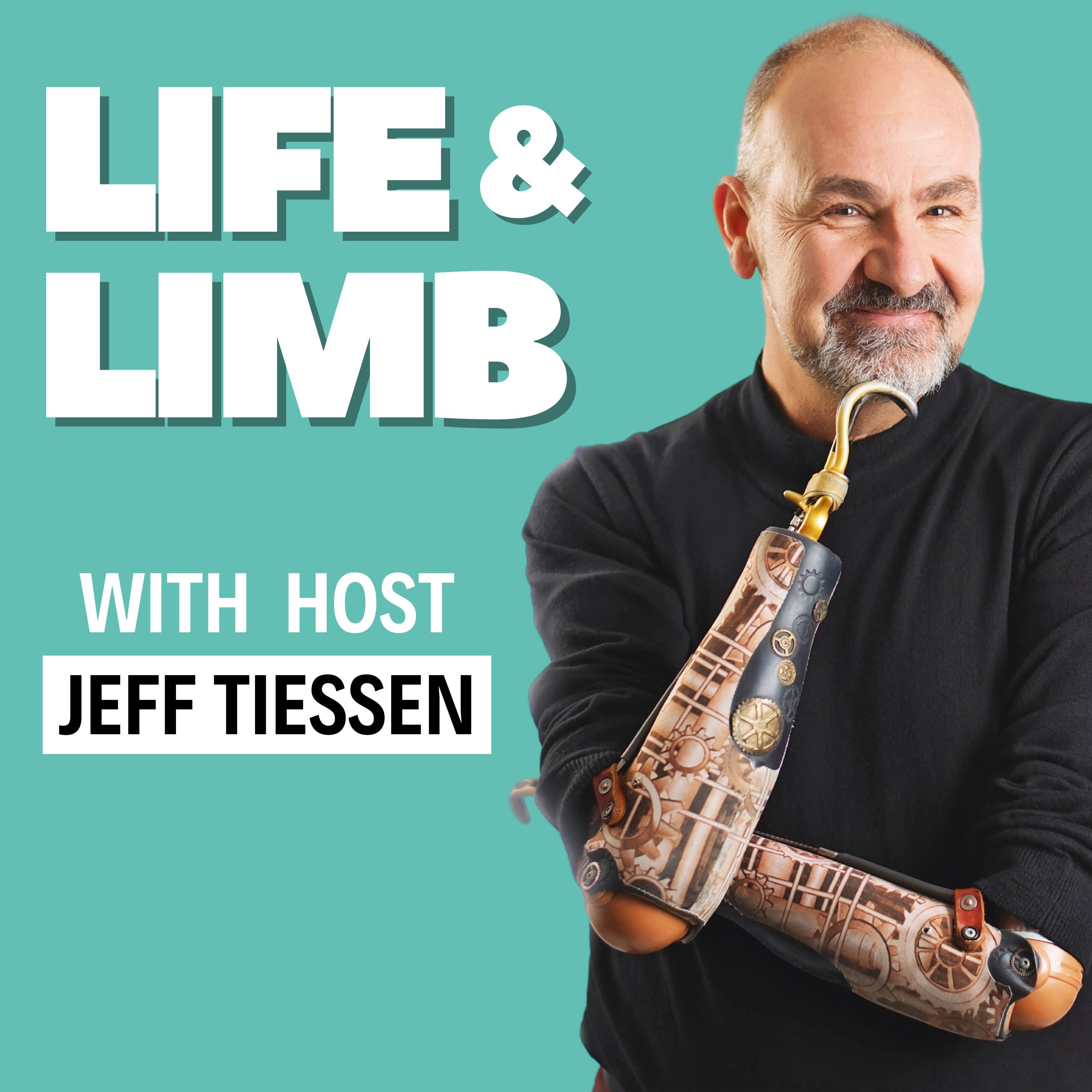
[00:00:03] Speaker A: Welcome to Life and Limb, a podcast from Thrive magazine all about living well with limb loss or limb difference. I'm Jeff Thiessen, publisher of Thrive magazine and your podcast host.
My guest this episode is Angie Sandow, who I recently met at a Limb Loss and Limb Difference awareness month event.
And when Angie grabbed the microphone, it was such a joy to listen to her put a humorous spin on so many every everyday things that she and and we in the amputee community experience.
She's an inspirational speaker and humorist. And Angie is also a singer, songwriter and shreds on her guitar in her band Lefty and the Goons.
In her documentary Angie Tales of Determination and her book From Chemo to Throttle, she shares how she has responded to challenges related to her limb difference and primarily others attitudes toward her finding strength in adversity and in her love for music, football and motorcycles. Angie is a big proponent of getting out of our comfort zones.
Angie, we have so much to talk about.
But first, welcome. How you doing?
[00:01:13] Speaker B: I'm good. Thank you so much for having me.
[00:01:15] Speaker A: My pleasure.
You'll recognize these words, born different, built strong, a phrase you use to describe yourself. Plain and simple, right to the point. So we won't start with born different. We'll get there. But let's start with built strong. What does that mean to you?
[00:01:36] Speaker B: I don't know anymore because after these past few days, I don't feel as strong as I was a little while ago.
So built strong, it just means having strength and confidence in yourself.
And the joke that I referenced is I've been having a bit of problems with the old body the past few months since December, and I had a, a scare a couple of days ago because the, the body is telling me you're built strong, but you gotta slow down a little bit. You're not 15 anymore.
So that's the. It's like I said, I always try and find humor and stuff, but really
[00:02:17] Speaker A: that, you know, like your motorcycle, it, it needs maintenance as we age. Right.
[00:02:22] Speaker B: You know what? I think it's the motorcycle that did it. And so we had a little talk in the garage this morning, my motorcycle and I, but.
Yeah, but that's to me is what, is what Build Strong is all about. It's just having confidence in yourself and being true to you and not letting people deter you.
[00:02:42] Speaker A: Yeah. And I want to talk more about that and those are some of the messages that you share in, in your presentations and your humor at the mic nights.
But let's not drift from the born different.
[00:02:56] Speaker B: So.
[00:02:58] Speaker A: And I Know you don't like labels, but share a bit about your physical difference. And I say difference intentionally, too, because I know you don't like the word disability either.
I'm right.
[00:03:09] Speaker B: You're right. I don't. For me, I don't like it. For me, just because I think it's. A lot of people assume that if you use that word, then there are things that you can't do. And that drives me crazy. Just drives me nuts. So listen, we all have labels, right? But I, I think a lot about Keith Richards who wears a skull ring. And the reason he wears a skull ring is, you know, if you pull the layers back, we're all the same. So I, I try and keep that in the back of my mind. So I was born with a limb difference. So this is my right arm and was so much more because my mom told me that when the doctor was picking me up, he nearly dropped me because the right and the left side are totally different. And never got an explanation. I never even asked about it. But after doing some research, I think I was born with a condition called Poland syndrome. And pollen syndrome is what. When one side of the upper torso is underdeveloped. So for me, it was. It was this. So the whole arm is different. I found out just from talking to my chiropractor the other day that somebody. Did you notice. He said, your, your forearms, your elbows, you're not, they're not the same length. I said, oh, that explains some other twisting that I've been doing. Here I am.
[00:04:18] Speaker A: You're missing. Missing a hand and a wrist, essentially. Right. For anybody that's listening.
[00:04:24] Speaker B: That's right. Missing a hand. Well, yeah, the hand is underdeveloped. The wrist doesn't bend.
The forearm is very small. The, the muscle on the, on the right arm is. It's, it's, it's a lot smaller than what would be on a traditional arm. My shoulder, my right shoulder is smaller.
I have no pec muscle on the right side. My breasts never developed on the right side.
And now if you use technology, you will see that my hips, the right hip is a little smaller. It's kind of inverted a little bit.
My spine is kind of. I have a bit of curvature in the spine. That's from the years of not having the same weight on either side, because with a missing muscle and everything like that, so that impacted the knees. So the knees are a little bit off.
The right eye drifts. The right eye just never got the memo to catch up with the rest of me. But that's that's, that's the fun of it.
[00:05:17] Speaker A: Yeah, I'll bet it's tough catching you, catching up with you. Anyway, you. You're on the go all the time.
Yeah. Like you, you shared with me as a kid. You. You wanted to play football, you want to play hockey, you wanted. You wanted the uniform and talk about that.
[00:05:35] Speaker B: So. I was raised by my parents. You know, I wasn't raised as. As being different in any shape or form. I. I was raised just to go out and get it done, you know, reach for the stars. And I was always encouraged to do whatever I set my mind to. Although my mom wasn't really happy when I wanted to start playing hockey because she didn't want me to get hurt.
And when I grew up, girls didn't play. They didn't play hockey, they didn't play football, they didn't play those kind of contact spots. Sports.
I was born in the 60s, so there I'm dating myself, so I wanted to play these things. I mean, I got into it through my father. My dad, we used to sit and watch sports all the time. So we would always be watching football, hockey night in Canada. That, you know, and it was just something that I. I wanted to do. And when I look back, it's interesting to me that I wanted to be the goalie. And, you know, goalie wears a mask, right? So I wanted to wear the goal, be the goalie. I wanted to be the catcher in baseball, there's another mask left and right, the stopper.
And I wanted to be the quarterback in football.
So I think back to all this stuff, and it's like either you're. You're the one that's getting everything going or being the last, you know, the last point of defense. And it's just. Yeah, it's just something I really wanted to do and I had to be authentic. So if I was going to play, I had to play with the boys.
You know, no disrespect to anybody. You know, this is just how it was back then, that girls just didn't do it. So I would, I. As I became a teenager and stuff, I would go to local rinks or stuff, and I'd already had the gear on for being a goalie. And I'd say, my name was Angelo. And Angelo, I had a mask on. I say, hey, kid, who are you? Yeah, Angelo. And it's funny, people notice what they want to notice. So nobody noticed that on the right side. It wasn't even the same glove didn't match what was on the left side, it was a, it was a junior glove on the right side, a senior glove on the, on the left side. And the arm was shorter. But people don't notice. They, they see what they want to see. Right? So same thing with football. I mean, the only thing that they saw, they never saw that, hey, she's throwing a ball, but, you know, the arm is different. No, they saw that I was a girl, right, But I, I wanted to play organized sports. That, that was the thing. But yeah, girls didn't do that. I think we, we once talked about my, my dad got me a tryout for a boys football team and I was all set to go. And I'm showing them how they throw and how I could catch and everything. And they wanted me to be a punter and a field goal kicker. And yeah, if I, if I didn't get my way, I would just walk away. Isn't that terrible? But no.
[00:07:57] Speaker A: Well, you told me you were shy, but you picked, you pick positions in these sports that are kind of spotlight positions. The catcher, the quarterback, the goalie.
[00:08:07] Speaker B: But you're, you're, you're doing something with people, but you're still doing it independently. I mean, I was shy when I was mostly when I was a little girl and, and when I was in school, so now my parents weren't there. You know, it was from the time I was a little girl maybe to my first corporate gig managing a team. All through that, growing up, I had a tendency to be shy, and I think I always had that. I wanted to come out and be social. I mean, I was social. I mean, I play with the kids and I'd organize, you know, getting the kids together and play games. But I was, if I didn't feel comfortable, I would tend to hide my arm.
So I would tend to have it like kind of behind me or you know, position myself in such a way that maybe I'd fold my arms so people can see it. And I think even as a young kid, it was, I didn't want to be seen for that.
[00:08:57] Speaker A: Yeah, that 70s, maybe even 80s mentality too, because I remember for myself being a double arm amp and wearing prosthetics, you know, we'd go to a lot of concerts now you'd appreciate that. And you had to get the three quarter length jersey, right? The concert jersey. But I would have my mom or grandma sew extensions on the three quarter length to hide my arms, although two prosthetic hooks sticking out the end. I mean, I wasn't fooling anybody. But yeah, that cover up consciousness in, in those times. Right?
[00:09:32] Speaker B: Yeah. You know, it's funny, I would, but. But my, my sleeve was still. If I had like a turtleneck on. Her sleeve was still rolled up because my. My parents always said, you know, this is who you are, be who you are. But it was the looks. It was the looks I was trying to avoid at a certain time because I get frustrated because as soon as they.
They decide what I could and couldn't do, like, I. I remember in elementary school, you know, we did a lot of like, sports orientated games, you know, and one of the things was playing like softball. And the gym teacher said that I couldn't catch. And I was playing with a hardball with my father in the backyard. I mean, I knew how to catch. And people tell me stories about Jim Abbott and I don't know if you heard about Jim Abbott, but he was a professional ball player and there, you know, how he would. He was a pitcher and how he would have his glove and he. He'd throw because he only had the one hand and he would throw and then he would quickly put the glove back on his hand so he could catch. I was doing that when I was a kid. So when my dad found out that my gym teacher said that I couldn't catch, he went down there and set her right. And it was just things like that that would just. It would just drive me nuts. So I think that was one of the reasons why I would hide it. And the other one was I got so sick and tired of, hey, kid, what's wrong with you? And now you become. You're getting older and that's the first thing. And the look. The look would drive me crazy. I mean, the way people would just look at you was either pity or if, you know, it's. It's mostly it was. It was pity or just disgust sometimes based on. When we grew up, it was just like, how could you be out in public?
[00:10:59] Speaker A: Yeah, no, I remember those times too. I was a pretty good athlete as a kid and made the school soccer team in elementary school, which is a big deal, right, that you're talking about the uniform you're wearing the school jersey. And I remember the coach coming. We had a weekend tournament at a nearby school. So very exciting. And I remember the. The coach, who was a teacher in the school, came in, knocked on the classroom door that I was in and asked to see me in the hallway, you know, so he's calling me out, you know, spotlighting me right away and says, yeah, I don't think you can play this this weekend? Some of the other parents are a little bit worried about their kids safety with your. Your hands. Right. So what's the kid to say? Okay, coach. So my mom knew right away when I got home something was up, like your dad, you know, back to wherever and oh, she hopped in that, you know, big long station wagon with the woody panels on it, off she went to school and yeah, she was back in about 10 minutes and said, yeah, you'll be playing this weekend. But it's like you say, the looks, the feeling of that there just wasn't that welcoming or belonging feeling. It wasn't a lot of fun for me, you know.
[00:12:10] Speaker B: No, I can only imagine because I get angry and, and you know, as a kid there was going to school, I, I wasn't a violent kid or anything. I mean, and again I was shy and at one point my parents got me a prosthetic. Right. And, and with the hook, with the elastic band back then I started using that thing as a weapon and because I found that if I would, I mean they were heavy back then, you know, these things were. And there was metal in them. Right. I mean, you know, if somebody started laughing or pointing at me or excluding me from activities that I knew I could do, I would just start hitting them and then they'd stop making fun of me. But then, now you're more isolated than when you. What you were before. And I learned very quickly that being a bully is not the right thing.
[00:12:52] Speaker A: Right.
[00:12:53] Speaker B: And I, I sometimes I don't remember what I did five minutes ago, but I'll never forget my principal, Mr. Owen, meeting with me and my mother and encouraging me to cut it out.
And just because some kids calling you a mechanical hand, you know, you, you, you, you are the only ones that can control how you are going to react to somebody. People are going to say and do, no matter what, no matter what you look like, you are the only person that can control you. And I, I learned that at a very young age and I'm very thankful. I mean my parents tried to teach me that all the time, but they're not there. You know, when you're in school.
[00:13:23] Speaker A: Yeah.
[00:13:24] Speaker B: And you're in that environment, mom and dad aren't there. Right. So you do what you can to make yourself feel safe.
[00:13:29] Speaker A: Right.
[00:13:29] Speaker B: That's, you know, what it was. Yeah, yeah. But don't tell me, you know, and I have to say sorry that you mentioned, you know, school too. And I, and I had one teacher, Mr. Benjamin, he never saw me as different than any of the other kids. He, he was from Wales and he would organize, you know.
Oh, my God, it just left my head. The sport, rugby.
And, and this was in high school. And I said, well, I want to play rugby. And he says, and he used to call me Sandwich. And he said, well, I wasn't going to exclude you. You're going to not only be playing rugby, so you're going to be playing the rough rugby. So it's good and bad. Right?
It's just a blend of everything that you go through in life.
[00:14:08] Speaker A: Absolutely. Before we leave youth, Lefty in the Goons, you've written a song that you perform called Not a Girly Girl. Is that a tribute to your youth or is that a lifetime reference?
[00:14:24] Speaker B: It's just, it's, it's just about. Yeah, the whole thing just talks about. No, I guess in a way, because when I grew up and the girls, you know, I, I, and when I talk to groups, I talk about how the toys back then, it was either Bissell Sweepers or the Easy Bake Ovens or the Barbie dolls. Not that there's anything wrong with that, but this girl didn't do that. This girl wanted to be out there getting dirty. And that's really what it's all about. When I say not a girly girl. I, I, I, I just wanted to do things that were, I guess, not always associated with girls at that time, you know?
[00:15:03] Speaker A: Montreal Rebeller, I think the Montreal Rebeller.
[00:15:06] Speaker B: That's it. That's, that's why I cheer. That's why when everybody was going for the Canadians, I was going for the Sabres.
I have to be that one town girl.
[00:15:14] Speaker A: Won't even take on the Habs flag. Okay.
[00:15:17] Speaker B: That's the thing. Because when I lived in Montreal, everybody was cheering for the Habs and it was easy.
So, yeah, you can't do the easy stuff.
[00:15:27] Speaker A: Well, speaking of not easy, here's my, my segue and I, I, we're gonna get to your motorcycle world shortly before we do, and maybe using a bad pun, shifting gears here, you speak really openly about your experience with breast cancer, and that happened back in 2014, if I have that right.
And, but you also talk about a really positive side to it, and that's not you just still being here, which is very positive, but it kicked you in the butt, as you say, in ways, in other ways, let's say talk about that, because that kind of launched the authentic you. Right.
[00:16:06] Speaker B: Yeah, I, that, that really changed. Yeah, me.
So I, It's a, this, this whole thing started in 2013, but I finally got diagnosed in February 2014. And I had always wanted to ride a bike and, and I had a moped when I was a teenager, right? That was my motorcycle at the time. But, you know, time, time takes over, life takes over, and before you know it, the years go by, right? And I got diagnosed when I was 50.
And I, I remember saying to myself, if I survive this thing, I'm going to ride a motorcycle. Now the way I looked at. And I'm a worrier, I have the best of both worlds from my parents, right? Determination, strength, humor and worry. My mom didn't worry, my dad did, even though he wouldn't admit it. Love you, but I got that.
So of course you're worried about, am I going to die? That's the first thing.
And when the doctors were talking to me and my husband was there all the time, you don't hear anything. It just sounded like familiar with peanuts and the Snoopy thing and you hear the teacher, you know, all I heard and, and I, I, I met a lot of nice, kind people.
I met one of the nicest men I never hoped to meet, and that was my oncologist.
You know, you never hope to go through something like that, but you become part of a very special club. And I've known a lot of people that have gone through similar things and worse, and there's nothing you can do when you get that diagnosis. So it's, what, what are you going to do with it? And I, I thought, you know what, this is just another chapter. I know some people say before and after, I just say another chapter in life and what are we going to do about it? And, and try and find humor in it. I mean, I always say I was on drugs that Keith Richards even had to pay for to get the same sensation that I didn't, right? So if the world was sideways, I just pretend I was a big rock star and.
But I decided to get the bike and I said, too much, too much time has gone by. So I did two things. A, I decided I was going to get a motorcycle if I survived it, and B, I was going to get out of corporate because I've been a corporate for a long time and I enjoy corporate and what I was doing, but it was just time to make a life change.
So I try to turn it into, to a positive. And to this day, I think it really helped me be more empathetic to people and their situations, be more understanding, patience. I still don't have the best of it, but I certainly try, and I just think it helped me to really grasp onto how fragile life is.
Yeah.
[00:18:34] Speaker A: And you talk about, enjoy what you can do every day. Right.
[00:18:38] Speaker B: Enjoy what you can do every day. If you have pain or whatever, you're having a bad day, pick yourself up and surround yourself with as much positivity as you can.
And yeah, I'm still in contact with a lot of people. I mean, it got me involved in a lot of different things, too. I mean, for example, I'm involved in the Patient Family Advisory Council of Oncology at Trillium Health. So I see it as a positive because honestly, once you get this diagnosis, there's no turning back.
Right. All you can do is look forward.
[00:19:07] Speaker A: Right, Right.
[00:19:08] Speaker B: You know, well said.
[00:19:10] Speaker A: You're a professional speaker, an author, blogger, subject of a documentary film. You seem to have a real drive. There's another pun. You seem to have a real drive to, to tell your story.
Yes. And why is that?
[00:19:25] Speaker B: You know, the real thing that started this is when we had an ACDC tribute band called Bear Rump. And if people want to surf that, I cannot promise that you won't find something that you shouldn't see. But you.
The ACDC stuff, we were doing a gig for sick kids. It was a charity gig. And it's funny, I, I don't know, for, for people that can see. I mean, I, I'm. I'm just showing a prosthetic. This is the tiny little prosthetic that I use. So it's kind of made of. It's very light metal. It's got Velcro on it. And it, it has a, A place where it holds the pick. That's the prosthetic that I use to this day.
And I, I. People don't see it when you're playing. And then I get. Well, I want people to see it because I want to demonstrate what's possible when you're playing. And when we did the sick kids benefit, there was a little guy and he was standing to the side with his father, and I heard him say, look at her little hand. Look at her little hand. And, and he was beaming and smiling. And when we took a break, his dad said that's the first time he had smiled in a long time.
And, and that just made me think, you know what? I think I got something to offer here.
So when we were doing the band, and in between sets, I'd start talking to people and start sharing a little bit. People would come up and share stories with me because I think we're all in it can inspire somebody. Right. We all have stories and the stories that I'd hear and. And I never forget I was a firefighter. And he said, you know, I lost a finger, I got it reattached. I've always wanted to play guitar. If you can play guitar, then what's stopping me? And I'd start to hear more of that. If you can do this, what's my excuse? And. And. And I just thought, wow, I think I do have a story.
And is, how am I going to tell the story and to whom?
And. And that was part of the whole going through the breast cancer thing, too, was thinking about, how am I going to do this and walk away from corporate? So it took a while to start building what I wanted to do. But the feedback that I get, I. I don't try and be a talking head, and I try and talk and tell my story just like I'm doing to you. And I want. I like interaction. I want people to respond and say things back because that helps me and inspires me every day.
[00:21:24] Speaker A: Like a conversation.
[00:21:26] Speaker B: Like a conversation, yeah. Yeah. That's so important. Right.
[00:21:30] Speaker A: You weave humor through it. And you call yourself a humorist and not a comedian. Is there a difference?
[00:21:36] Speaker B: Well, some people said, well, Yang, you know, you should be in a comedy show. And, you know, there. There are some. I mean, I do. I. It depends on who I'm talking to, you know, but oftentimes what I'll do is I'll start off by telling my story very briefly, and then I'll go into other stuff. I mean, for instance, the group that I had yesterday, now we're talking about age and say, you know, now here we are, and we. I mean, we try and find humor in life because life can get very serious, especially in today's world. It seems like we're surrounded by negativity. And anytime you go on social media, the first thing you're probably going to see is what murder happened, what this, some awful, horrific things. So I think it's very important.
So I am putting humor into the story. But there are certain moments that it's not so funny. The only thing I. I tell people is, I don't want you to shake your head or tisk and say, poor you. How did you manage that? Because we all have things that we've been through, right?
[00:22:28] Speaker A: Yeah, we all have a story. I like. I like how you put that. Yeah. Do you just.
Through the lens of life, do you just see things observationally as. As funny or funny in things? And it was just Something that. It was a default as a kid.
Where does that come from?
[00:22:46] Speaker B: I guess my. My parents had a great sense of humor.
[00:22:48] Speaker A: Yeah.
[00:22:49] Speaker B: And I honestly, you know, they grew up in the depression, you know, and I don't recall them ever showing fear, although I'm sure they did at some point. You know, when your daughter doesn't come home, when she says she's going to be home and then you get home, they're mad. Right.
But I don't recall them ever showing fear, disappointment, anger. They were always upbeat. Always upbeat. It was always the positive. It's always the positive. And I try and do the same thing because positive makes you feel good. And I think sometimes we're kind of like batteries. You know, the batteries has a negative and a positive, and if you put them two together, something works.
So I think that's. It's just. You gotta look at things that way because if you don't, you're gonna get yourself so down. It's easy to be negative. Right. It's hard sometimes to be positive. And that's why I think it's so good, you know, to listen to podcasts, like what you do, to be social, to be out with people, which can sometimes be the hardest thing to do.
[00:23:43] Speaker A: Yeah, for sure. Yeah. Amputation can be very isolating, particularly at the beginning of the journey where people still feel very alone. And, you know, it doesn't surprise me because there is. Yeah, there's lots of information online. Right. But it's. It's not human interaction so much or.
[00:24:04] Speaker B: Oh, I know. Well, I mean. And you know, I'm considered to be a congenital amputee, which I never heard that before, but apparently I'm a congenital amputee because I was born this way. But I have to tell you something. I mean, because it's never going to stop. I mean, just the other day I was at the Legion, because I go to the Legion because that's what we do.
And playing Ukre. And there's three new people that I had never met before, although one had seen me previously. So we're dealing the cards, and I'm holding the cards. So I know this is a calculator, but you can pretend it's a card, and I'm holding it like this. So the person number one, it's like, this is a joke. Person number one says, oh, I was wondering how you would hold cards.
I mean, but inside now I'm mad. Even though it's. I list, it's the intent. Intent. It wasn't said with any ill intent. Okay, person number two had to pipe in, and so now it's time to shuffle the cards. It's my turn to shuffle. So person number two says as she's taking the cards, it's okay, I'll shuffle the cards for you. And I'm taking them back. And I'm saying, no, it's okay. I can shuffle the cards. And I hear, are you sure? Now we're all around the same age, okay? And I'm thinking, the head is saying, yeah, I've been doing this for more than, you know, 50 some odd years. I know how to shuffle cards, but I keep my mouth shut and I keep smiling. Now personal number three has to say, you know, I know somebody and. And they're in my family and they've got deformed fingers and. And they do the same thing that I do. It amazes me. And all I was thinking was, get me out of here. I just want to win this hand so I can move to the next table. Right. But again, none of it was said with ill intent. So I think that's part of it. It's part of understanding. You got to be accountable, too, for how you receive the message.
In their minds, they're being very supportive and friendly. And in my mind, I'm going shut up and just deal the. You know, like, let's just play the game and move on.
[00:25:51] Speaker A: Yeah.
[00:25:51] Speaker B: But at some point, perception, it's just the perception, right?
[00:25:54] Speaker A: For sure, for sure. And at some point I meant. Well, I don't know, it gets a little tiring, maybe that. That shouldn't be an excuse anymore.
[00:26:07] Speaker B: My parents taught me to just smile and wave kind of thing. I was. Listen, my dad had a. A was very opinionated. I was gonna say a different thing, but he was very opinionated. I have that. So my problem is I was ready to go. Like, I was ready to start saying stuff, right? And I think now my parents, I can still hear them because, you know, they're watching me from above, and I can hear them saying, don't say anything. Just smile and move on. But I agree. There was a part of me that says, really? I mean, seriously. Yeah, but, you know, I faced it. But, like, when I got diagnosed with cancer, I remember going to one of these groups. You go to a group, you know, everything's a group. And there's a group of us that were diagnosed and we're talking about different diagnosis. And mine was called triple positive. And this woman beside me, she didn't know that. And I hear her talking to a friend saying, I really don't want to be diagnosed with that triple positive, because that's the worst one you can get and you're going to die right away. And in my head I'm going, oh, honey, you don't know.
Right? But again, when do you.
It's, it's how you deal with it. Right?
That's why.
[00:27:09] Speaker A: Yeah, yeah, you're right. But, and as we know, you've had comments all your life, as have I. And, and that's something I want to talk to you about next, about the judgments of you in your life, but in the context of your second family, another group, maybe you refer to groups, your motorcycle family.
And I could see in the documentary how important those folks are to you and your life. And like you said in the documentary, you've never had to prove yourself to them. And you're, you know, driving a motorcycle with one hand and I see how you do it and I understand how you do it, but to, most especially to cyclists, I guess, but, and they don't judge you, you said as well. So you emphasizing that, it would seem to me that you have experienced judgment in other walks of, of life and, and having to prove yourself. Is, is, is that a fair assessment?
[00:28:10] Speaker B: Absolutely. I mean, I, I once went for a job interview at the government of Ontario. This is in the early 80s, and it was for a file clerk. And it was, was really my first big interview, you know, so imagine you're intimidated already I'm in this big room with three people and they're asking me all kinds of questions about myself and everything. And I knew it was coming. I knew it. My mom was waiting for me in the reception area and the question started about how would you hold a file?
Because this is back in the early 80s now. So you're talking about files, paper, everything's paper. How would you hold a file? And you have to have a card that you're going to write on that you took the file and you put it back and you know, in the filing cabinet where you took the file from. How would you do all this?
And I, I just looked at them and said, well, how would you do it?
And it, that was the end of that interview.
I remember my mom seeing me, she said, so soon. You're out so soon. So, you know, but I mean, another one where I went for a job interview at a coffee kiosk and I was interviewed by the owner's wife the night before. Everything went well. Next day, show up and he just looked at me and I, I again, you come to know that look. And he just looked at me, and I was saying, okay, what can I do? What do you want me to do? Boil water? What do you. You know, he told me to wait. He went on the pay phone shows how long ago it was, and he made a call, and I could hear him talking to his wife and saying that, how did you. Why did you hire her? She shouldn't be seen in public.
You know, when I tell that story, a lot of people go, oh, that's terrible. I said, but wait, there's more. Because I went to my boyfriend's after, and he called this fellow who made the mistake of answering the phone. They had a conversation. And. And then my. My now husband said to me, he said, you should be hidden behind a desk somewhere. Now, you see, I see that as a positive because I still talk about him and I still think about him, because he was the reason that I decided, no, he's going to stop me from what I want to do. And people have opinions of, no matter who. Who you are, what you look like, and I'm going to get it done. And if I get down, I actually think of him because how he was motivates me to continue going.
[00:30:14] Speaker A: Right.
[00:30:14] Speaker B: You know, and that's just some of it. Right. I mean, we all face stuff, but that's just a little bit of how you get judged based on how you look sometimes. Right.
[00:30:25] Speaker A: Well, you have a great talent of making lemonade out of lemons.
That can be. That can stick with people negatively for many, many years. Right?
[00:30:36] Speaker B: And it's still with me. It's still with me. I mean, it's like I talk about being in a bathing suit. You're at your most vulnerable. And to this day, I'm still uncomfortable sometimes. So, I mean, to say that I'm always out there and. And being strong and inside. You carry these things with you, you know, But I'm not going to let it prevent me do the things I want to do, because somebody might look. I mean, I. You know, one time I was. I was. I was at a pool, and we're on vacation, and I got the bathing suit on, so everything's there. You can't hide. You can see the arm and everything. And these kids are looking at me and pointing and laughing. And inside, I still felt like that little girl. And it's unbelievable, you know, And I still felt embarrassed and uncomfortable and shy.
And I thought to myself, you know what, Ange? No, no. Talk to them. And that was hard for me. And I approached them and I said, hey, you Know, you guys are laughing and everything. Why don't we talk about. What do you. What are you looking at? What do you, you know, you want to talk about the arm. And I started talking to them and explaining everything and then, you know, kids being kids. Okay, that's cool. And then they got, you know, bored and they moved on. And now I wasn't the center of attention anymore. And that was really hard for me to do.
[00:31:39] Speaker A: Yeah, I would imagine. Yeah.
[00:31:40] Speaker B: But I, I did it. And. And that's, I guess, one of the reasons why I do like to share the story, because the more people you can educate, maybe, you know, they'll look at things a little bit differently. Right.
[00:31:49] Speaker A: We hope. Yeah. No, for sure. And again, it's that conversation, right. When you went, then just chatted it out. The kids got some familiarity with, with you and.
[00:31:59] Speaker B: Right.
[00:32:00] Speaker A: Didn't see you as, you know, something very different. But yeah. Yeah, good for you.
When you're doing presentations, speaking presentations. What, you've shared a lot of messages. Messages already. But what are some of the messages that you present to your, Your audiences and maybe more specifically, the, the takeaways for them that you want them to leave the, the auditorium or the venue with?
[00:32:24] Speaker B: Don't allow yourself to be judged and, and don't judge others. You know, get. We all judge. Let's face it, we all do, all of us. But it's what you do with it. Right. But really, I mean, you know, I'm at a stage in my life where now it's not so much the arm, it's that I'm older. And now you're too old to do this, and you're too old to do that. And, you know, kids will put you on an island if they could. Right. I mean, one of the things is, so, you know, you're too old to be on social media and say, well, you know what?
Really? And they'll say, yeah, you know, it's just for young people. Well, so is oxygen, and I use that too.
So it's. It's just trying to, you know, we all have limitations. It doesn't matter what you were born with or what you look like, if you have all your appendages are not. We all have limitations. And as we go through life, guess what? What you did maybe 20 years ago, you might not be able to do it now. We change. But it's what you do with that change and it's what you do with any hardships that come into your life. Because I'll tell you when, when things get dark it's easy, Try, try not to sit there by yourself. It's easy to do that and then get sucked down that, that rabbit hole. Right.
So I hope that by sharing some of my tales and everything, I encourage people to get out and do what, whatever it is, ride their motorcycle, you know, write their own story. And I think that by being social is one of the most important things that you can do to help yourself and your mental health.
And it's okay to get down as long as you pick yourself back up. And when you think about stuff, don't, don't look back with regret because you can't change it anyway.
It's done, it's gone. It's what you're going to do with that future. And also trying to encourage people to be the one for somebody else. I've been blessed and fortunate. I've had a lot of what I call the ones in my life that have encouraged me and motivated me. And you don't have to know that you are the one for somebody else.
That's not what's important. It's important, though, that you just do what you feel is right to help someone else.
[00:34:24] Speaker A: Yeah, that's a great message. And I know there are more because I've, I've heard you speak.
I like what you say about, don't be so hard on yourself. Give yourself a break. Right.
[00:34:34] Speaker B: Yeah, you gotta. Right. Like all the whole life I'm pretty hard on myself.
You know, here I am. I guess I would be a bit of a hypocrite. Right. Like, I mean, but I, I, but it's not a good thing to do. I recognize that.
[00:34:46] Speaker A: Yeah.
[00:34:47] Speaker B: Like, for instance, I'm going through some pains right now. I've been dealing with this since December, and they got pretty bad. And it's in my lower back and, and I mean, I had golfer's elbow and I'm dealing with stuff in the right arm, but the, the hip, my hip, my right hip and my spine, it's. This is all things catching up because of pollen syndrome, because all my life I twist and, and things to compensate and you don't realize you're doing it, but my body is telling me you're not 20 anymore. And I don't listen because I, I try and push through. Sometimes that's not the best thing to do. So I have an angel of a doctor that's working with me now who, you know, I had a big, my flare came back big time the past two days, and I rode over 700 kilometers on the weekend. And he Said, yeah, guess what? You overdid it. You know, it was this first big ride this year. I said, actually, yeah, this is like, it was really the first time I was on a bike for the season, And I went 700 kilometers in three days. And he said, yeah, no, don't do that.
80 kilometers. He said, try 80. But that's hard for me. Right? That's hard for me because I'm. But you gotta sometimes take a step back and it's. It's hard. It's not a failure. Don't see it as being a failure. You know, it's just something you gotta do. You gotta listen.
[00:35:58] Speaker A: Yeah, yeah. You'll learn.
And we have talked a lot about the magazine and on podcasts about aging with. With disability. I mean, all of us are aging into disability, but we as amputees and others with disabilities are aging with one as well. And like you said, you know, the mechanics of your body is catching up with you in how you compensated like many amputees. Cheese. Right. So, yeah, something that we need to be very aware of and not be so hard on ourselves and patient and listen and all that. Good advice.
[00:36:34] Speaker B: Yeah, right.
[00:36:34] Speaker A: I mean, I'm not taking either just yet.
[00:36:36] Speaker B: Yeah. I mean, my doctor, he says to me, you know, Ange, you know, you only have, you know, the one arm and one hand. I said, really? Because I didn't know.
But, you know, he's the first. I think it's also, again, the one. My whole life, if I. Because I've been dealing with these types of things since I was actually in my teens, you know, the pains and all that stuff. And the. The people that I would see, they would only treat the area, you know, so if I had a pain in the lower right hip, it was just treat. He's the first person that's treating all of me and looking at everything, like the whole skeleton and the muscles and everything, and how I'm different on both sides and so trying to strengthen me the right way.
[00:37:14] Speaker A: Yeah.
[00:37:15] Speaker B: So I'm happy I found them now, why I couldn't find him 40 years ago. But you know what? Again, don't look back. I'm thankful that he's in my life now. Now. Right.
[00:37:22] Speaker A: No regrets.
[00:37:23] Speaker B: No regrets. Helping me get on that motorcycle. No regrets. Yeah. Get me on that bike.
[00:37:29] Speaker A: Last one for you. And you've talked about this before, and you referenced it earlier in our. Our chat here about accountability resides within. I. I love that statement.
Elaborate on that.
[00:37:46] Speaker B: Well, everybody's got opinions.
And. And I find that in today's world, people get mad at the drop of a hat. So I, I just like the example that I gave about Euchre. I mean, I have to be accountable for my reactions. And that's one of the things I learned very young, thanks to my parents and my principal that I talked about.
We're in a world you don't know what you're going to experience and everything else. And you got to be accountable for how you handle the things that come your way. I mean, we're all going to have positivity and negativity. What do we do with it and how do we. How do we handle it? Because if we lash out, maybe that doesn't make us better than the people that are saying things to us. You know, I, I don't know. My way is, Is always. If I really hear something I don't like, I try really hard not to be sarcastic.
But, I mean, I've heard all kinds of things, right? Like, I mean, I have heard, is your arm made of titanium?
You know, I, I hear all kinds of crazy things, and then I'll try and make jokes about it. Right. You know, I, I sometimes I say my, my arm melted because of stupid questions.
Like, you know, I just. I. I don't know. I just. Things just come out sometimes. You know, you're walking on. On the boardwalk, you know, again, you're on the beach, and people keep looking and looking. I mean, I, I just say, you know, hey, listen, here's your opportunity. Take a picture. It's only going to cost you five bucks. I'm less than 0.1% of the population. You might never see a person like me again.
[00:39:13] Speaker A: Right, right. And then sign it for them and autograph it and then charge even more. That's what I'm saying. Yeah.
[00:39:20] Speaker B: No, I guess that's what it's all about.
Yeah. Sorry.
[00:39:25] Speaker A: No, it's okay.
When you said that, I mean, I, I sought in that context for sure, but, you know, we're quick to blame, you know, but I love my prostitutes, but when things go wrong, you know, quick to blame him, but we got to be accountable, you know, I should see, I should take some responsibility for saying that. Maybe I let the maintenance go a little long this month, you know, and I.
So.
[00:39:51] Speaker B: Well, it's just like, you know, talking to the doctor today about the pains that I'm in and all the exercises that he's given me. I mean, he's a chiropractor, but not a traditional chiropractor. I mean, he does a lot of exercise and strengthening and everything else. And I didn't want to admit that I overdid it.
[00:40:05] Speaker A: It.
[00:40:06] Speaker B: You know, and then I got mad because that's what happens, because. Are you saying I'm not going to be able to ride my bike? Because I have a trip planned to Alabama and I've got all these roads that I'm going to be doing. It goes, no, but you got it. You got to do step by step. So, yeah, I got to be accountable to me, too. And I also. What's the hardest for me at this stage of my life, as I said it earlier, it's really hard for me to realize that I'm not 15 anymore, even though my brain says I am. It's. It's. It's hard. It's hard to be at that part of your life. For me, that I'm always active and I. I. Even with weights, I love to do weights, which is different for me, given the right side, because again, no pec muscle and stuff. So then I get mad because I can't do the same amount of weight on the right side that I can on the left. Because everything to me, I have to be perfect on both sides, and it's not going to happen. So it's accepting. It's acceptance and things, and it's. Listen, we fight that battle, all of us. I think maybe every day in a certain capacity, it's just getting beyond it.
Yeah, right.
[00:41:03] Speaker A: I love the. Where the humor comes in. Exactly. I love the way that you can give that kind of advice and probably giving it to yourself a little bit as well. Right. We're all in progress. Work in progress.
[00:41:15] Speaker B: Yeah. I give it to myself, and my hubby gives it to me.
So I have news for you. You've got stuff you got to work on, too. It's not just me, but, you know, I think sometimes it goes back to just hearing you can't do this. And all my life, I felt like I have to prove myself, and if. If I don't, if I'm unable to succeed at something to weight, I want to succeed at it. It drives me crazy. And, you know, one thing about the motorcycles, people, when I wanted to ride, some people would say, hey, you know what, Ange? Why don't you try and ride a trike? Because, you know, that way you don't have to worry about this, that, and the other thing. And inside I would say, you know what? That's great. Thank you for the advice. I really appreciate it. You're concerned about my safety, but, no, I want to Lean. And I hate gravel. And a lot of people I know that ride, don't like gravel and avoid gravel. But when I avoid gravel, to this day, I'll hear, well, that's okay, because you, you, you know, you only have one arm. Well, I have two, but I, you know, I do ride with one. But that's not why I want to avoid gravel. It's just because I don't like it. So you still hear it, you know, and it's, it's, it's, it's just something, I guess, you know, you just, it, it gets me really upset sometimes. Don't judge me. I'm not turning around from the gravel because I cannot do it. I can.
Like, there's a road here called the Forks of the Credit, which is about an hour from where I live, and it's like an S curve.
It's very sharp. It's like a switchback. And I've done it, but I don't like it. So when my friends are going riding, I'm saying, are you going to go do the forks? They'll say, why? Because I don't like it. Yeah, but that's okay because, you know, you have one hand and you do a great job. No, it's got nothing to do with it. It's just I don't enjoy it. It's not my kind of writing. So sometimes you still are.
It's like they, they try and bring you back and you just gotta keep going forward, right?
[00:42:59] Speaker A: Yeah, yeah, yeah. That's great advice that we do.
Like we talked about earlier about attitudes toward you, they're out there.
It's what do we do with them and how we respond to them. Like, exactly like you have.
Great advice. Angie. Thanks very much for joining us on On Life and Limb. We'll wrap up with that. Thanks for listening, everyone. If you're interested in connecting with Angie, reach out to her from her website. And that URL is laughs with angie.com and I'll try that again. Laughswithangie.com There's a S on the laugh part, laughswithangie.com and you can read about others who are thriving with limb loss or limb difference and plenty
[email protected]. and you'll find our previous podcast episodes there, too. Until next time, Live well.