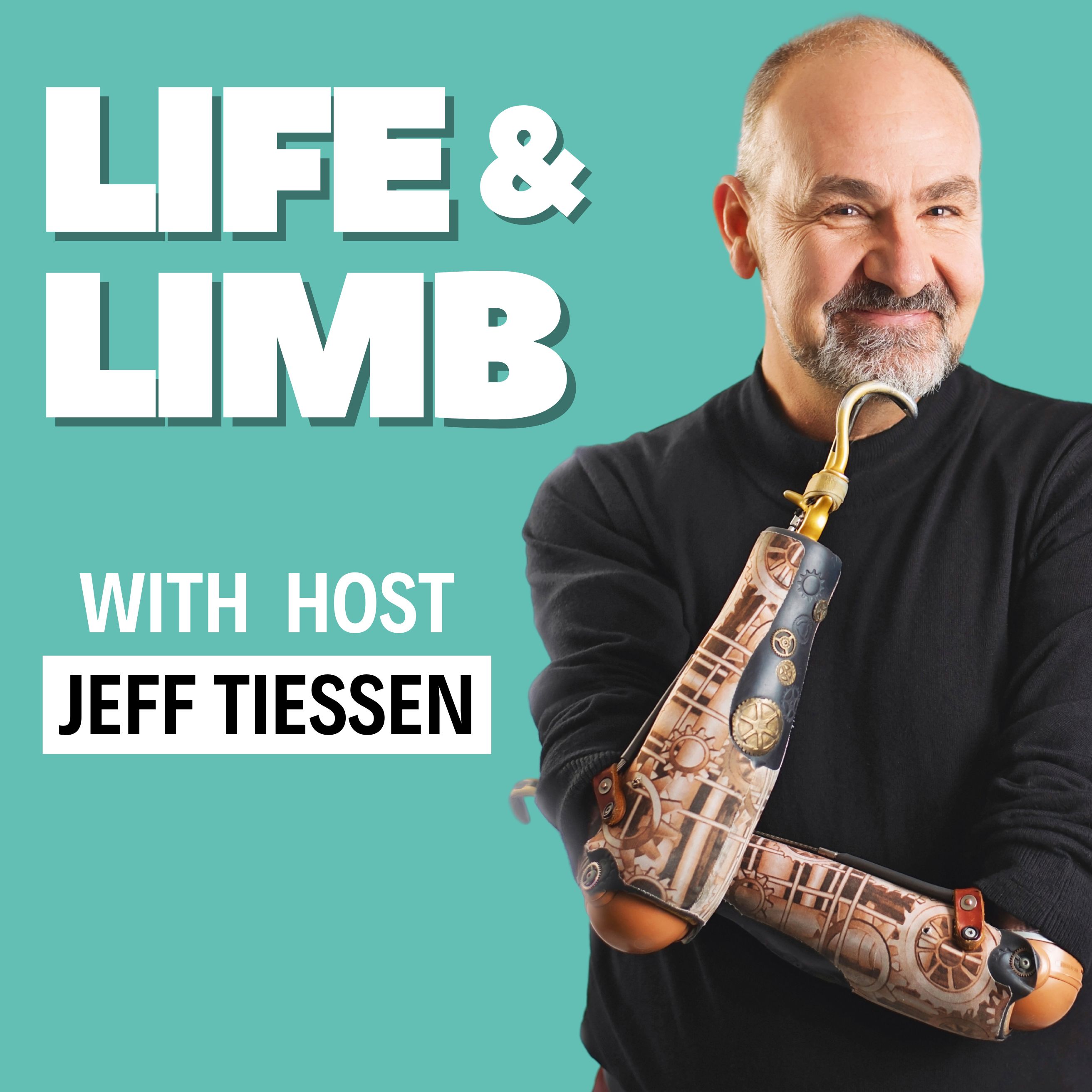
[00:00:02] Speaker A: Welcome to Life and Limb, a podcast from Thrive Magazine all about living well with limb loss or limb difference. I'm Jeff Thiessen, publisher of Thrive magazine and your podcast host.
My guest this episode is a remarkable woman who in many ways was, was transformed in ways that she really never imagined when she lost her left leg above the knee for years ago.
Rosalind Hakeem. She's a force in the amputee community, especially when it comes to peer support.
But that's not all of it. She's a respected author, a public speaker, an advocate for and about the amputee community.
And what I find makes her so unique is her complete honesty and transparency about her difficult journey after her motorcycle accident.
She celebrates her victories big and small and finds a lot of pride and joy in her accomplishments.
But in some ways, and at the same time, she's remained the same person she was before her amputation. She's still a fitness model. She still cherishes her motorcycle, a new one, of course, and she still approaches life with zest, living a mile a minute sometimes. You'll see.
I'm so pleased to welcome Brampton, Ontario's Roz, as I call her Hakeem. Roz, welcome. How are you?
[00:01:26] Speaker B: Oh my God, Jeff, it is absolutely amazing to be here, to see your face, hear your voice and it's an honor to be, you know, part of this podcast. I know you're reaching a great group of people and I'm excited to, you know, to share, share the next hour with you.
[00:01:42] Speaker A: Great to have you. And as we'll talk about, you know, in the next 35, 40 minutes or so, all the work you've done for, for Thrive magazine and that' I've, I've gotten to, to know you and we'll, we'll, we'll lean into that. But every chance I get to chat with you, you always have something new to share. You're, you're doing something unique or new there. You're pursuing something unique or new. Volunteering, speaking.
What's the latest right now?
[00:02:12] Speaker B: So, yes, I'm definitely moving. I move fast through my, my tasks and my goals and as of lately, my main focus, of course, first and foremost, my community will always be the strength of everything I do.
Right now I'm working on starting my own business.
There's a lot of training that goes into that, so I'm doing sort of a full time role at my permanent job and then taking on every excess and spare minute of the day to commit to my new business, which is all about Inclusivity. And bringing people together. So it's definitely something that has taken over all of my passions and all of my time and my strength.
But it's very thrilling and exciting and I'm so, you know, I'm very aware of, of how good I've got it at the same time, for sure.
[00:03:05] Speaker A: That's great. Your week has how many days? Seven. Like the rest of us.
[00:03:10] Speaker B: Somehow I find a little bit more than mine.
[00:03:15] Speaker A: I know you do. Efficient. You are. I, I would say, yeah.
You know, I remember you writing about life one year after becoming an amputee and you were thinking about, I think as you said, overthinking, you know, all the obstacles in front of you as a new amputee.
How would you cope was a question. You asked what you could or couldn't do, how people would react to you, how you would mentally and physically manage life. And you said that gave you a lot of anxiety and I can imagine it would. A lot of anxiety come. Come with that. And something I've always remembered and I know I jotted it down then and I still keep it. You said my life became a dryer of tumbling emotions set on high speed. Emotions I didn't even know existed. Pretty cool quote. You're four years an amputee now. Do you still think about those things or how do you think about those things that were those anxiety fueling obstacles four years ago? Three years ago.
[00:04:20] Speaker B: Wow, what a dramatic writer I am.
It's funny because that's, that one's right there. It's called what I Know for sure. And that was sort of my, my year recap of how I, you know, everything that I have gone through and mentally and all of these emotions. And I think I've mentioned in one of my other editorials that thrive that the emotions never go for me, have never gone away. They just sort of depleted below a few more layers of surface. But I feel I can, I can go back to those moments almost immediately if I get caught into a trigger moment or something that I've been thinking about or reflecting on.
So those emotions that tumble the dryer to me still stays.
There's probably not as many pieces of clothing, slash emotional anxiety that is, that was there three years ago because obviously we develop emotionally and we get, you know, we get to spend time with ourselves and we get to grow within our new identity and we kind of get to settle down a little bit. But definitely emotions come and go very quickly for me. Just not as powerful, I would say.
So, you know, everybody kind of from you know, you look at, look back and you say, wow, four years. Like you must, you must know it all by now. But I think to myself, like, if you look as if at a four year old child, you wouldn't expect that little child to have it all figured out. So, so there's days where I'm on cloud nine and I know exactly where I'm going and nothing bothers me. But you know, there's days where it's tough and it's hard and I sit in the car and I look at people that are fully able, having a good old day, and it's easy for them to navigate. And then I think back, like it's, you know, those, those challenges are still, I still face all the time because I'm aware of how it has impacted my life.
Um, and, and I am an overthinker by nature anyway, so when I get to think about certain things, I think deeply about them. And some, sometimes they're really good emotions and I'm really proud of who I am and my, the community I'm in and the people I'm surrounded by and how, how this life change has added a lot of value and positivity into my life. So sometimes I go into an emotional overthinking of great things. It's not always bad, but you know, like I am, I do feel like an emotional dryer of emotions of how I worded it. It still does exist with me.
But like I said, it doesn't hit you as hard. It's not, maybe it's not on high speed.
You know what I mean? That dryer is not on high speed.
[00:07:11] Speaker A: Maybe just a medium tumble.
[00:07:14] Speaker B: Yeah, we're on a tumble of dryer. Yeah.
[00:07:16] Speaker A: But all the while you're, you're, I mean, you're a writer and to use a writing pun, sort of you're rewriting your own story, your own narrative. If you're accomplishing things that probably three years ago you sat and thought, take riding a motorcycle again.
Did you really think you would be doing that?
[00:07:37] Speaker B: No, I, no. I mean there was, there was every cell in my body, there was determination. And I'm, I looked at every single modification that can come about and I was looking at getting licenses on how to do these things and, and looking at hiring people and modifying a bike to ride, to ride again. And it was in every passionate. But I, but also I think deep down inside and every time I searched for a new idea, I found there would be a challenge that came with it. So when I found, you know, the Three wheeler Ryker rally that I first bought, and I think I told you I bought it, you know, same time I bought my prosthetic. So my priorities are always in place. But I knew my. My sanity needed that so much because it was just something that I didn't want to give up and I wasn't. I had given up so much, and I just did not want to give that up. And when I found the three wheeler and I found a new community of people and, and you zest for life and I can, you know, I can still seek that little thrill inside me and, and, and I can feed that giddy fun.
You know, Roz version I am definitely was honestly one of the best things I've done for myself. And the more people that come to me and say, are you crazy? The more I know it was a good choice.
[00:09:01] Speaker A: Hey, that's your validation.
[00:09:02] Speaker B: Yeah.
[00:09:03] Speaker A: All right.
[00:09:05] Speaker B: People don't say that to me. I think people find a lot of inspiration in that, like me returning back to my passion. Absolutely. But, like, the ones that are shocked be like, oh, my God, you did what? And I'm like, yeah, I did that.
[00:09:15] Speaker A: Yeah. I'm wondering if you wonder that yourself. Yeah.
I want to talk about peer support. You're a certified peer visitor with the Amputee Coalition of Canada. And I remember you, you telling me about when you were in rehab, you know, right after your injury, that you wanted to talk to someone like you, a woman around the same age, maybe the same amputation, maybe even someone who lost a leg in a motorcycle accident, if possible.
But there wasn't anyone that was really relatable.
So, I mean, appropriate peer visitorship, we might say. So let's talk about the importance of that, that appropriate peer visitor, and how realistic is that kind of match with your experience now as a, As a peer visitor?
[00:10:05] Speaker B: Yeah, I love that you're asking me that, because I try to talk about this in every conversation I sort of have that's relevant. Um, I know that I was definitely in a really, really dark place and I was very confused and I was lost and, you know, like, from even reaching out to you and writing in Thrive magazine, as, As a first time, like, I just don't know what tomorrow is going to bring. And I don't know. I don't need to know what five years from now. I just want somebody to talk to that I could relate to and just somebody that I can connect with and somebody that can just understand on a deeper level of how I feel and maybe, like, show me how, how their Life is now and what, what can, what can come of this for me? And because it was such a challenge to find that sort of perfect peer that brought me so much more.
It found, it gave me a true reason to become an MPT peer supporter through the MPT Coalition of Canada.
And I find that, you know, there is a lot, a lot of people that are amputees due to the motorcycle accident. And so I find I'm available and people reach out to me because of that reason specifically.
I think it brings our community a little bit closer, but through peer support, I mean, as you know, like just last week you connected me with Eleanor, another female motorcycle accident survivor, above knee amputee. So literally everything that I was searching for when I was looking for peer support, she was able to find just through, you know, conversation and community and amputee coalition.
And I think it's just it. The conversation that we had was so immediately connected and so warm on so many different levels. And having that connection and support with somebody is crucial in their time.
I know that, you know, Sunnybrook and St. John's were trying to find the right connection for me.
And it was obviously, you know, during COVID it was a bit more challenging to get people out here, but I make it a point to be available for peer support at any given time to any single person that ever needs it, regardless of, you know, what their wish list is like. Right.
I think it's just about connecting and being there for somebody. But for me, I've been able to connect with a lot of people that were looking, that have been looking for. It's been great. It gives me. It gives me fulfillment, you know.
[00:12:35] Speaker A: So good to hear. I mean, and I've talked about this before, I think, on the podcast. I lost both hands when I was 11 in, in 1977. So there was no, you know, Internet, of course, there weren't magazines, there weren't resources. And where my parents found handy Andy to come and visit me in the hospital, I'm not sure, but we were decades apart in different demographic for. For sure.
He had a. An oddly illustrated picture of himself on the side of his van that, you know, I'm sitting on my hospital bed watching this guy pull into the parking lot, and I just knew this was not going to be good for me. All intentions were, you know, bless him for coming to see, to see me.
And it was probably the last time we ever saw each other. I mean, smelled a little bit like Whiskey river and Tobacco Road all in one and a bit disheveled and I'm not trying to be disrespectful. That's who he was. And it's just, I mean, I think I sensed after a while that that's not who I wanted to be. So maybe it was a great peer visit. I don't know. But I've always, you know, hearkened back to the importance of that appropriate peer support. It just not any amputee is the right amputee for us sometimes, right?
[00:14:01] Speaker B: Absolutely. And I. That is hilarious. And just, I mean, I. Yeah, there's so many things I want to say to that, but I'll leave it for now. But when they found my peer support when I was in St. John's as, as all, it was great intention, like you said, but it wasn't a great match. And I think now with the amputee coalition growing so f. Fast and quickly and people really looking to be there for each other, the peer support group has grown so, so much.
I am, you know, I'm 39, so I'm in the kind of the age where I can steer towards a bit younger and then a little bit older for the range. And then, you know, like I said, a lot of motorcycle survivors, but a lot of lower limb amputees exist more.
So there's a lot of relation in that side as well. But like our community through ACC and then Thrive magazine, especially just connecting people organ, there's such a bevy of people that are available and, you know, people hesitate to contact peer support maybe because they don't know what it's going to be like, or they may be. They're scared or intimidated or like they don't want to bother. Maybe they don't want to. They feel. They already feel like a bother to somebody and they're like, oh, I don't want to reach out to stranger. But honestly, like us as peer supporters, as you know, I know for a fact, like, you know, how many people you've helped along the way. And it gives us just as much joy and it gives us just as much fulfillment to be there to be and it's. And all we want to do is like, you know, help our fellow amputee and community. Right.
[00:15:31] Speaker A: So, yeah, for sure.
[00:15:32] Speaker B: I love your support.
[00:15:34] Speaker A: And there's that aloneness, right, that people, you know, they don't realize that there is a greater community there to be part of and, And Thrive in. So there's my segue.
You wrote for Thrive magazine for a couple of years. We even created a new department for you called Beginnings. And your articles were Just so honest, so vulnerable. And you shared absolute fears and exhaustion and frustrations, but victories too.
But let's go back to some of those fears and feelings and how you figured them out. And I think the first piece you wrote from us was the fear of leaving the safety, the safe zone of rehabilitation to come home to a home that wasn't the home you remembered it or what it used to be. So, you know, from the front steps to the steps inside to all of it. But I'll let you take it from, from here.
[00:16:33] Speaker B: Yeah. You know, that's a memory I'll never forget. Is, is being in the hallways of the rehab. And it's one thing to be in the hospital because I feel like there's a lot more life in the hospital, like beeping and, and people walking and nurses checking in. And then, you know, like, you don't have time for the reality to settle in. And then I think for me, when I got transferred to St. John's it was like reality, it just, it was just bam. And everything got really quiet and there were no people walking in the hallways. And it was just, this is all you knew. This little, these little four narrow, wheelchair accessible soft ground, you know, drugs, like, like your painkiller. Your nurses were there, like this was your home now. This is, this is reality hit. This is your new reality. And this is all I know.
And so when they were sending me home, it was the most terrifying thing because I need, like I wouldn't have had, I don't have my nurses. I have stairs. I have three flights of stairs. I don't know how to use my prosthetic yet. What if I fall? What if I, what if I need to cook? And how do I do everything by myself? I live all alone. And it was the most terrifying, you know, returning from rehab, I think was the title of the first editorial. And I remember sitting and a lot, a lot of fear and a lot of unknowns and a lot of loneliness and a lot of long, scary nights. And I had no one to talk to and I didn't have any, like, you know, professional people. I don't have, you know, live in roommates or family or friends or A cat. I don't have a cat.
I just, I have me and my thoughts and you know, I, I, I, I was going through a lot of the, that, that reality when I got home and it was scary and I didn't even want my neighbors to see me.
And so I would go through my backyard because I, you know, I have to avoid my neighbors. And my house that if you ever come by, it's beautiful, it's well decorated, it's very raw, you know, a lot of personality in this house. But when you come home and you're by yourself and you're learning how to walk and you're learning how to cook and you're learning how to stand and trying to balance and not, you know, overdo with your other sound limb and all of these thoughts and things you have to constantly think about and you're just tired, you know what I mean? Just tired. And you just want somebody to help and take care of you. And so the home became enormous. Like my little, my little three bedroom townhouse.
Not even a standalone, just a little ittyp house. It just felt so large. And the, all of the equipment, you know, and all of the new processes and ways you have to handle, and then you're handling financial stuff and then you're handling, you know, the PSW coming in and then just kind of like taking over your space and then leaving you and you're like, you don't even know what to say to all of, all of the new faces, strangers in your home. And, you know, I think returning from rehab was most, the most challenging part of it all. And it was just like everything was taken away from you. Your independence, you know, you're still learning to do so much, especially at the beginning.
[00:20:10] Speaker A: Yeah.
[00:20:10] Speaker B: And you don't want to always constantly lean on people. I know I talk to so many people through my peer support and especially at the beginning stages when they call me and they're like, man, I don't want to ask my husband to keep doing all this stuff for me or my kids, they got other kids of their own and I don't want to, you know, so all of us feel like we want, we don't want to add weight to other people's lives because they already have so much going on. And so I think trying to take it all on ourselves and like dealing with all the changes that are happening with you physically. People, like there's surgery after surgery, after surgery for some people.
There's people that have like, you know, new, new equipment. There's some people that have so much buildup and issues going on with their surgery, they can't be in a prosthetic, so they're learning how to, you know, learn to use a wheelchair or there's upper limb ish. You know, amputees that have a whole new set of challenges on their own. So I think returning from rehab was.
While I was writing that for a thrive, I think I was the rawest version of me because everything was brand new and, and I. It was almost a way to connect with people like me that were going through, but also an outlet for myself too. And I think that's why I poured so much of myself into so much of my writing.
[00:21:30] Speaker A: So it begs the question, how did you get to here? What. What did you do? I know you've talked about time being a good friend.
Yeah. How did you move through it?
[00:21:43] Speaker B: I'm gonna sound really cheesy.
[00:21:47] Speaker A: That's okay.
[00:21:47] Speaker B: It's the truth, I think. What? Yeah. I don't know how to speak any other way, unfortunately. And sometimes it gets me in trouble.
But when you start doing these things that feel like moving mountains, even though like, you know, maybe they're not as huge things, but like, you know. Okay, I'm going to say something really simple for me was like doing a load of laundry by myself and putting it away by myself without getting like super exhausted. And these little itty bitty things that you think so little of when you get that, that reassurance in yourself that you completed something all on your own that gives you this, like, it's almost like a battery being filled.
And after more and more tasks and more and more things that you're doing independently, like you sort of kind of stand up a little bit taller in your own skin and your own body and then you kind of gain confidence and, and things like that. But I also want us mention like the big things.
Like, as you know, getting back into fitness was something a must do for me.
And I still say to this day that that was probably the biggest, the biggest 180 that I got to, you know, I was able to do in my recovery was go back into the scary world of fitness and, you know, go back to the things I love and be able to do them in a brand new modified way. But accomplishing that was all I needed to kind of get myself back into the rhythm of who I was and who I want to be now.
So as you say, like, I always celebrate the big stuff, but I never, ever, ever let the little things go. Like the first time I cooked for my friends at my house, like I cooked for my friends on my, my prosthetic. And it came out so good.
I don't care what they say, I think it came out great.
We'll ask for their vote later. But it was just like, it was such a great, you know, it was such an amazing thing that I. That gave me such like A boost of confidence and, like, reassurance that I'm going to be okay and I can do more. And then I traveled by myself for the first time. That was a big, big thing for me because I was terrified.
So, like, everything that brings you fear sort of brings you and you and you, you know, overcome it. Whether it's a small little thing or a big, big thing for you, depending on who you are, I think it just gives you, like, you're a little piece of yourself back. And after a while, like time does, is a very good friend of ours, a very good friend. If we use time wisely and approach.
[00:24:26] Speaker A: Appreciating those small victories, you might say, right. They add up to something bigger in the end, don't they?
[00:24:33] Speaker B: Oh, yeah, they do. They matter. I think they matter more than the big things, to be honest with you. But, you know, I, I, even to this day, like, four years later, if I do something that, like, I was like, dreading and I'm like, overthinking and over thing and this, and I do it, I feel so great. Don't you feel so good when you get something like, you know, that was going to be a challenge to you done? You're like, yes, laundry.
[00:24:55] Speaker A: Laundry doesn't give me the thrill that it gives you. I, I gotta say. And I'm a terrible cook, so I stay out of the kitchen, but these are choices. These are choices I make.
[00:25:05] Speaker B: So what would be, like, something that would kind of give you, you know, like, give you that. That independence thrill again?
[00:25:12] Speaker A: Yeah, that's a really good question. Because after, you know, all these years, I'm still find a, an easier or better way to do something with my prosthetic hooks and.
Yeah, that's a really good question. Just because I've been so independent for so long, but I guess becoming more efficient and as I'm aging with a disability, that becomes important conserving energy where, where possible. And we know for, in our community, energy reduction is, Is a huge thing, right?
[00:25:49] Speaker B: Huge. Huge.
[00:25:50] Speaker A: Huge.
[00:25:51] Speaker B: Maybe for me, maybe that, like the cooking thing. And then independence probably wasn't the first, first stages, but now if I go for a nice long run and I commit to, like, you know, If I say 25 minutes and I do it, it's the best feeling. And I feel, I feel like a champion when I walk out of there.
So maybe not like, you know, cooking as much as before, but those little things when you're at the beginning of it, those things like, well, you've come on, they mean more, you know, what I mean, for sure.
[00:26:16] Speaker A: Yeah. Those are first times, right?
[00:26:18] Speaker B: Yeah, yeah, yeah.
[00:26:20] Speaker A: You talked a little bit about identity and yeah, let's move in into that self identity. Yours in particular, Ross.
I mean, you were always on the go. You traveled a lot before you lost your leg. You lived around the world. You were in fitness competitions, adventures, freedom on the motorcycle.
Admirably you've returned to some of those things. Maybe most of these things. But has the journey been about returning to your old self? And what I mean by old self is pre injury or is it more about discovering a new ra. A new self identity? Or is it a balance between the two?
[00:27:05] Speaker B: You're so good at this. I gotta. You're such.
Your questions are just. I don't.
[00:27:13] Speaker A: Came from your work in three, but thank you. Thank you.
[00:27:17] Speaker B: My identity is a tough question.
So I don't think I will ever stop trying to be or follow the passions that I had before just because I'm still very, very passionate about those things.
Motorcycles, fitness. I'm terrified to travel. If anyone's got, you know, any, any pointers, that would be great. I'd love to travel again, but that's not something. But also I think naturally. And I, you know, I don't know if it's because I'm growing older and that's just how my life would have been anyway, but definitely my priorities are different, for sure, and my passions are different. And so I struggle with the identity thing because I love how my life is going in the direction that it's going.
But I also always wonder, like, Roz, if you weren't like, if this accident didn't happen, where would you still be doing this? Or did you. Are you doing this because of your accident?
So I always wonder, like, I don't know if that, that's coming out clear, but it's not like I don't want to be doing what I'm doing now. I just always wonder which side of Roz chose this.
Like, is it because I'm chasing a dream that I have now or is it because I'm trying to run away from the identity that I once had?
And it's a little bit of a trick. I always say I think about this all the time by myself too.
And I always feel like I'm like right on the cusp of the two and I'm. I struggle a little bit because I loved who I was before.
You know, like, so independent. I was just. I was so, like fast and like hyper and like, you know, I moved to Australia like in a overnight And I came back to Canada just because I felt like it. And I would go to Thailand and, or, you know, hang out with friends and go out for like an, you know, to the beach all night and you know, and wake up to sun, sunrises and stuff and like life was just easy and, and fast and I love that so much. And now I think, am I slowing down or maybe pursuit, pursuing new, bigger, calmer dreams because I'm getting older and I'm maturing Or is it because I don't, I don't have the capacity to do what I once did, but the fact that I still, still find my way to my motorcycle and still find my way to fitness and still model and still like writing, like, writing is such a blessing, you know what I mean? Like, I wouldn't have had the opportunity before, but now it's like become one of my most favorite thing to do and it's like, so again, like, I'm not sure if it's coming off clear but like it's sort of, it sort of sits with, with like which identity is choosing this one? You know what I mean? Does that make any sense?
[00:30:17] Speaker A: It does. I mean, and it's dynamic, right? It's, it's always changing and what your interests are at the moment, what you're pursuing. I mean obviously you wouldn't be a peer visitor with amputee coalition. You wouldn't be a writer for thrive. We wouldn't be here today if you hadn't had the accident, but where would you be? And that, that's, that's a good question to ponder. So.
[00:30:40] Speaker B: Yeah, yeah, well, I ask, I get, you know, I, I get asked that quite a bit in my peer support visits for the identity, like how, you know, how are you coping with not being able to do what you used to do?
I get that question asked a lot and I think because that's something that everybody, that sits with everybody at the same time. Like, I think that's the phase that everybody goes through regardless of your amputation or your circumstance or the reason why you're an amputee. But I think people are always asking the identity question because they struggle with it themselves and because it's such a big, life changing, you know, thing that's happened to you. So it's kind of deciding to, to what's best serving you at the moment. And I think that's probably the best way to, to try and identify who you, who you want to be. Like what's best serving you and what's going to make you feel Good. And give back and.
[00:31:29] Speaker A: Yeah. And, yeah, life gives us reminders maybe every day that we, we don't have, that our limbs are different, let's say. I mean, I've got four, but my top two are just very mechanical compared to others. And you wrote something that was very personal to you, too. And I think it's something most of us, if not all of us, experience, and it's those microaggressions when we're in public, public, public places. I think the title of your article was the Grocery Store is My Battlefield, which I loved.
And I know exactly what you mean. I mean, I, you know, how often am I told how inspiring I am for grocery shopping or pumping gas, and that is not the ceiling of my abilities.
[00:32:21] Speaker B: Yeah.
[00:32:23] Speaker A: So, yeah, I would imagine a lot of our listeners can appreciate or resonate with this. So let's talk about the grocery store for you. Why is that your battlefield?
[00:32:34] Speaker B: The grocery store.
Oh, what you do. For me, the grocery store, it's a, you know what? It seems so simple, but it's really, it's, it's, it is. Oh, man. The grocery store.
I find every time I go into a grocery store or a public place to say, like, you get, you get a reaction regardless. And sometimes you get this excited, big fan energy. And like, everyone's like, oh, my God, you're pushing the cart all by yourself. Like, wow, like, what an inspiration you are to me. I'm gonna push my cart, and you've inspired me to become a better person. You're like, I'm just literally picking up milk. Like, I mean, I appreciate it. It's, it's the better of the two. Let's just say that the two approaches that we usually get, but it's just, it reminds you, like, I don't know what, you know, you should see what I do outside of the grocery store. I'm pretty cool. Like, I do a lot. I drove myself here. You know, you just kind of want to be snarky and sarcastic, but it's just a bit of, like, it reminds you of what little abilities maybe people think that you have.
[00:33:45] Speaker A: Right.
[00:33:45] Speaker B: But again, like, I, I, I sort of understand that approach a little bit more than the, the disgusted look. I get the most crucial, like, sorry, not crucial, cruel. I get the most cruel comments. And I don't know if it's where I live or because I'm, I'm always in, you know, I always, for comfort, I always wear, like, shorts or skirts because above me, amputee. The prosthetic just, it makes it so much easier if I don't wear long pants and I shouldn't have to cover my leg because somebody else's outside.
But.
And I don't know if it's a, it's a girl thing, I don't know, maybe because people don't think I'm going to be as aggressive so they can say whatever they want to me. But people come to me and ask like the most horrible questions and the most terrible comments and they will. Like I've had many times, not just once. Like families that would pull away their child if they're walking near me. And that just like, that'll break you at any moment of the day. I don't care how many years of, of empathy you know, of your journey you're in. It's it when a mother takes away her child in fear of you because you're in a prosthetic and you've done nothing to bring that forward. And you're just literally, I'm pretty cheerful. I'm probably walking around with a smile on my face, carrying my little basket bag of spinach, happy as hell, you know what I mean? And, and just for that sort of reaction or like I've gotten people like, what's wrong with you?
Or the good old question that we all face all the time, what happened?
And I say, actually, Kirsten from ACC told me, she said, just ask. Why do you want to know?
[00:35:36] Speaker A: Exactly. That's what I thought.
[00:35:38] Speaker B: I thought that just that was the most creative way to shut somebody up. And it's not insulting and it's not rude and it's just like a really mirror question, like, why do you want to know?
[00:35:48] Speaker A: And someone may, you know, Uncle Joe just lost a leg, you know, her Aunt Elsie, and they're looking for help. Or, you know, there may be a good reason, not just well intentioned, but.
[00:36:02] Speaker B: No, and I've had that. I've had that too. And when I say, why do you want to know? They say, you know, I'm considering surgery, for example.
[00:36:09] Speaker A: Right.
[00:36:10] Speaker B: Yeah. And I've had the. Or I was at Lakeshore beach and I was meeting up with my friend. I was on my, my bike and the random lady came up to me and she's like, what happened to. But the thing is, like, why don't you say hi, good place.
[00:36:24] Speaker A: Yeah.
[00:36:24] Speaker B: You know what I mean? Warm up the conversation. But I get it there at that time, there was a language barrier. I get it. So she told me that her, her, her nephew had just gone through surgery and is struggling with his prosthetic and I gave him my number, her, my number for him. And we connected. So it's not always a bad thing. But I think the way people ask as well, that tone in their voice and you, you can already see them staring at you from the corner of their eye, you know, your eyes, and they're in your peripherals, and they've been staring at you for 20 minutes straight, so you're already sort of defensive.
And so when they just come up to you like, oh, what's wrong with you? Or what happened to you?
[00:37:03] Speaker A: I find it a tremendous invasion of privacy. And generally it's people just fulfilling their own curiosity, selfishly. So that response, I love that. Yeah. Why do you want to know? It generally stops them in their tracks, doesn't it?
[00:37:21] Speaker B: It does. And before I used to be like, why do you like, you know, I used to be really, really like Isis. And my sister's very, very protective of me. And she'd be like, you mind your business. Don't talk to her. You know, and I love that too, because I'm not that feisty. But, you know, I, she's great, she's great protecting me. But now I, you know, when she sees me, I'm like, why do you want to know? And she's like, what? That's good. And I'm like, I know. Kristen told me that it is with other amputees too.
[00:37:49] Speaker A: And it's like, I'm almost 50 years in amputee, so I'm pretty thick skin to it, despite being kind of oversensitive guy, but, and I take a lot, and it's water off the duck's back generally, but there are some times when just gets me, and maybe it's because I'm tired that day. Maybe it's, you know, low tolerance. I shared this one with you, and I won't go into too many details, but I'm a regular on Fridays at a fast food restaurant in town, and, and generally the woman at the, the window tells me how amazing I am, and I thank her and, you know, but that, that gets tiring too. And in my, my last visit there, she wanted to show some of the other employees how amazing I am. So before she handed me out my breakfast sandwich, she gathered some from the, from the back of the, the restaurant, back of the house, and said, watch this. As she handed the, the bag out to me. And I, I, I just said, this is weird.
And she didn't understand, you know, why that was really wrong. And I tried to explain to her, you know, you kind of just made me feel like a curiosity or an oddity.
Why. And no, she, she didn't understand and I've been back since and we're mending fences. We are. But that one left the mark on me. That, that day I, I, it, it threw me off big time. So.
Yeah.
And they're out there. There'll be more into the wild and there'll be more.
[00:39:27] Speaker B: I'm very sorry that that happened to you and I'm very glad for that young lady that it happened to a wonderful person like you because if she had done that to me, I'm not as nice. So I would, my reaction would have been a very well taught lesson and I'm very glad that she, you know, I'm sorry that happened to you and it's, it's horrible to be, I don't believe, I can't believe she just would put anybody on display. You know what I mean? Like.
[00:39:51] Speaker A: Yeah, yeah. And not a young lady actually. She was middle aged or more so. She's, you know, been around the house probably. But anyway, we could tell these stories.
[00:40:03] Speaker B: I was, I was, there's that temple dryer of emotions that came right up.
[00:40:09] Speaker A: Thank you.
[00:40:10] Speaker B: For you. Yeah.
[00:40:12] Speaker A: Good thing you weren't in the seat position beside me, that's for sure.
[00:40:14] Speaker B: Oh my gosh.
[00:40:16] Speaker A: Listen, I want to, you know, work toward wrapping up and I have a last one for you here. And you know there's much to be said about the importance of gratitude and, and I know how grateful you are for, for many things and it's important to our mental health for sure. It's important to relationships with others.
So simply, what are you grateful for?
[00:40:40] Speaker B: Oh, that's such a beautiful question.
You know, that's probably the easiest one you've asked me so far.
I am, I am beyond grateful to be honest, for so much. And I, and I know it's going to sound cheesy, but it literally all starts with the community that you've helped me build and you know, the people that I have met since day one. I truly 100% believe that this all happened for the people I know now.
They have like so much love and so much support and people are truly there in my corner for me every single minute of the day. I've got people like you in my life. I've got communities from thrive, I have my prosthetists, my professional people that are looking for me. My new set of friends are amazing. My new career that has started because of this is in, is an endless blessing like every single day of my life. Even though I do have the people at the grocery store, but the people that truly matter, that actually are in my life, I have, they are top tier quality people and they are God sent. I have prayed for people like, like this my entire life and I don't think I would have ever come across such great people until I've, I, I did, you know, I did have this occurred to me and if that's the payoff, I'll take it every single day because the people in my life are, I, I cry because of my blessings. I cry all the time because I'm so aware of how lucky and blessed and I am. Like, I have had support from every single minute of the day. I've been so, like, I mean, I've won fitness competitions as an amputee. I was, I had the privilege in climbing the CN Tower because I had friends come from Calgary to do it with me. I've had, you know, I got to travel all by myself because people were going to meet me at the airport just to make me feel like I'm safe. And even, like, even on those trips, the flight attendants and the pilot came up to me and they were just like, they were like, well, you could say wherever you. And like, I know we talk about getting, you know, looked at or put on display, but sometimes it's really great to have that. And you know, like my prosthetist, Marty, you and Jeremy are always looking out for me. I had so many friends. I have parasport, you know, donating legs and I was the first female amputee above me to ever receive running blade through parasport podium. And I got to speak at the next event and you know, I get to be a brand ambassador for motorcycles at energy power Sport. And I'm on podcasts featuring with great, wonderful people and amazing conversations and like, I don't know, I mean, I've got frames of wonderful moments that I've. This wall was empty before, you know, this accident and it was just a picture of a flower. But now I get to celebrate accomplishments and I got gold medals and great photos and, you know, wonderful memories and people that if I, if I do feel alone or if I feel sad, I've got my community with me.
And I'm never, ever, ever blind to that because I've never had that before. And you're gonna make me cry at the end of the podcast. I knew you'd get me at one point. I thought you'd get me at the beginning. You got me at the end.
[00:44:14] Speaker A: So I did Good.
[00:44:17] Speaker B: You always get me.
[00:44:18] Speaker A: Well, the first time we did an interview for Thrive, yeah, we had to pause a few times. But that, that was many years ago. And Roz, I mean you're, you're giving all that back to, to folks too. I, I know you are. I mean the way that you've embraced the peer visitorship and, and how you're, you're helping others. So definitely a two way street. You're, you're earning, earning all of, all of that. But yeah, great, great answer. I thought it be a simple, you know, sun, sunshine in the, in the sea I'm grateful for.
[00:44:50] Speaker B: But yes, that too.
[00:44:52] Speaker A: Yeah.
[00:44:53] Speaker B: No, the people I have in my life are. I, I can feel love from every single one of them every single time. And that's that's just, that's all I've ever wanted my whole life. So I have it now and I'm very, very lucky. And you know, I get to meet wonderful people through everybody else like you know, meeting new friends like Sonia and then having her story through Thrive and people like Champ that are coming up next through the Motorcycle Survivor. These are all things that have never been, I would never have, I would never be part of. Right. So through this, you know, accident I've been able to find a lot of, a lot of great, wonderful people and I'll always be grateful.
[00:45:39] Speaker A: And again you, you, you're the captain of your own ship and you know, you've, you've brought all that wonderfulness to you and I know you give it, give it back. So if someone would want a piece of that, you know, good feeling and, and advice and suggestions, how does someone get a hold, get a hold of you? How could, how can they reach out and connect with, with Roz?
[00:46:03] Speaker B: I would love to connect to all of your listeners and if anybody has, you know, any conversations, advice or they want peer support and they can, you know, they feel a connection. Absolutely. I am always on Instagram.
I am 1/bionic_beauty 1 bionic beauty. You can always connect with me as well through writing to rozmail.com and that's writing W R I T I n g the number 2 r o z writingto razmail.com I would say social media is probably the fastest way. And of course you can read my many editorials on Thrive magazine in the past. There's always an addition.
Thank you you to Jeff for allowing me to share that and yeah, there's always more to, to obviously share with our, with our readers and our listeners now.
[00:46:58] Speaker A: All right. Well, folks, don't hesitate.
You know, if you have advice you want to share, you have questions, I know Roz will be there for you. So, Ross, thanks so much. What a wonderful time together again. Sorry to make you cry.
I can't help it.
[00:47:13] Speaker B: Our usual passing now.
[00:47:16] Speaker A: All right. And with that, this has been life and limb. Thanks for listening. And you can read about others who are thriving with limb loss or limb difference and plenty
[email protected]. and you'll find our previous podcast episodes there, too. Until next time, Live Well.