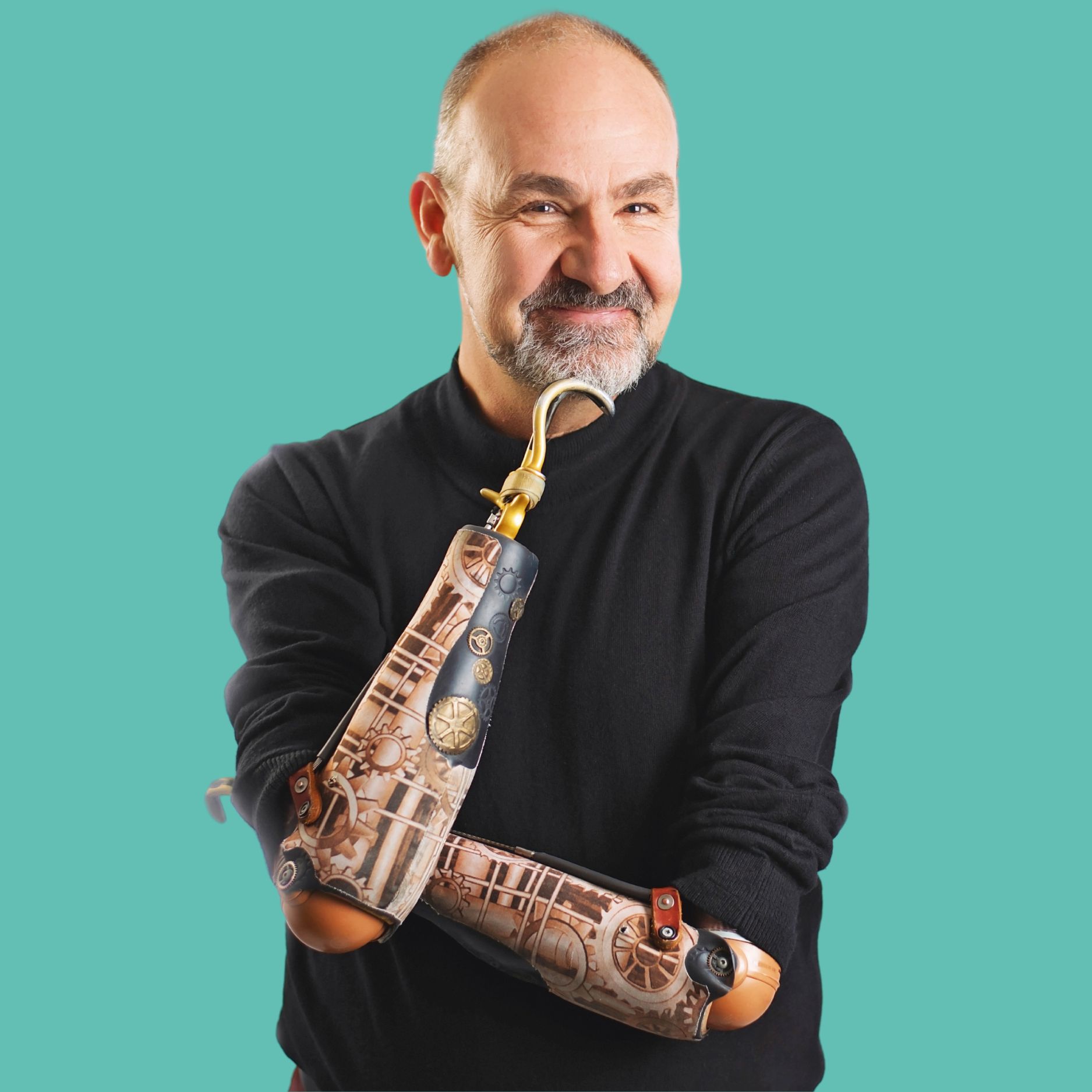
[00:00:03] Speaker A: Welcome to Life and Limb, a podcast from Thrive magazine all about living well with limb loss or limb difference. I'm Jeff Thiessen, publisher of Thrive magazine and your podcast host.
I've got two guests this episode, Deborah Latour and Bob Rudosi, two professionals who work together quite closely.
Deborah is an associate professor of occupational therapy at Western New England University in Massachusetts with areas of interest in prosthetic rehabilitation, global health and advocacy.
An arm amputee herself. Congenital actually. Dr. Latour is the owner of Single Handed Solutions, which provides consulting services to prosthetic manufacturers, researchers, clinicians, and those with upper limb absence. An author as well, she's also past chair of the Amputee Coalition's Upper Limb Advisory Council.
And that's just one of the many roles she's had with professional organizations, including the American Occupational Therapy Association.
Bob joined the prosthetics profession almost 50 years ago when he started a company in Colorado called trs.
After losing his left hand and not being satisfied with prosthetic technology available at the time for him, he started designing alternative body powered prosthesis for arm amputees. Like himself, he revolutionized the industry with the reintroduction of voluntary closing hand technology.
TRS was also a pioneer with its activity specific prosthetic inventions for arm amps.
Bob is now a consultant to fill our owned TRs and a presenter and an author too, active all his life. Name a sport and Bob has probably done it. But as I know, archery, weightlifting, running, skiing and water sports are among his favorite. Welcome to you both. And how are you doing?
[00:02:02] Speaker B: Well, glad to be here.
[00:02:05] Speaker A: Glad to have you. And me being an upper extremity amputee, this is a particular interest for me.
But let's start with trs.
Tell us more about why you started the company, started inventing new prosthetic technology, and what exactly is voluntary closing grip technology?
[00:02:28] Speaker C: Sure, Jeff. Well, thanks for the question. You know, my evolution in prosthetics was due to an accident I had when I was 22, a senior in college, and I was fit with the traditional split hook technology back then.
I would became dissatisfied with it over three or four or five different years of trying different kinds of technology.
I've always felt that I was kind of lucky in some ways in that my background educationally is varied. I have engineering, I got biology. I have a background also as a recreational therapist. But as a kid I grew up doing a lot of design work. I was a model. I built model cars, model airplanes. So I was a hands on kind of a project person. Even as A kid. So when I became, when I became an amputee when I was 22, I had some of the capabilities inherently being structural draftsman, machine draftsman, as well as in training in college, actually sit down and design things.
So in 1976, when I was going, getting ready to go to graduate school, I just sort of determined it was the time to design something for myself. And I never really envisioned starting a company or anything like that. But I had experimented with a lot of different types of prosthetic designs that were all body powered at the time.
And I stumbled on a couple ideas that thought were good. So I put down the criteria that I felt were most important for me.
I just wanted to be more competitively bimanual. With my prosthesis and with my split hook. I didn't feel I could get there. I felt that the split hook for me as a unilateral was holding me back in a lot of things that I maybe could do better. Couldn't hold the bow and arrow, couldn't hold on to rope and cylindrical objects as much as I would like to work correctly. Couldn't hold on to tools very well.
So I put down on paper what I felt were the criteria and I did some designs and I had a device. I scraped up $700 and I went to a machine shop and I said, build this for me. And then over a period of years we improved on that design. And then I started TRS in 1979, 1980, as a one product company had patented the concept. And so that's how it got started.
Your question about voluntary closing is a good one.
A split hook like, like you're wearing and like I've worn and like many, many people wear, a voluntary opening device is a device that's held closed, shaped mostly like forceps, so that you pull it open with a cable power muscle action and then it closes for you. So it's like having a passive vise on the end of your arm. For me, it didn't give me enough prehension, it didn't have the right shape. So I went to developing. I Voluntary closing wasn't a new concept, but it never been used really well in conjunction with an opposed thumb.
So prehensile, what I call a prehensor, as opposed to a hook, is something that grasps around like a monkey's tail wraps around.
So voluntary closing works especially well with a prehensor. And what it does, it's like having an active gripping pair of pliers at the end of your arm. The more energy you Output, the more energy you put into grasping, the harder you grasp. And as you relax, it follows these natural patterns of reaching and grasping that I thought for myself were more inherently functional and natural. And so because, as it turned out, I represented the majority of the. Of the market, so to speak, being a unilateral transradial, missing one hand below the elbow, I happen to fit into the market that you're being the largest part of the market. So as I develop things, it fit in and it fulfilled the needs of other people as well. And that's how the company grew to a great extent.
[00:06:18] Speaker A: So, great answer.
It's cable driven. Right? This is not a myoelectric or battery operated product.
[00:06:26] Speaker C: Cable driven, just like what you're wearing, you know, you have a double, double prosthesis, one on each arm. I'm wearing a single loop harness around my shoulder. The way I describe it to most people who aren't really familiar with prosthetics, who don't necessarily understand voluntary closing, I describe it like a bicycle break. You've ridden a bicycle and you squeeze on the bike brake lever. You have a directly proportional control over the calipers. This is like having a pair of calipers at the end of my arm as I generate, use body motions to pull on the cable. Much like when you're pulling on the lever of a brake. I can generate force. The. The thumb is just biased open. The thumb stays open all the time. I'm just pulling it closed. But it's very, very highly efficient because it doesn't take almost any energy to close the thumb. I'm exerting about three pounds of force to close this thumb. So holding it down, holding it, holding it in one place. If I was to hold the pencil takes very, very little effort at all. And it's one of the things that people don't really understand about voluntary closing is that people equate it with the difficulty of using a split hook. The more bands that you have on, the harder it is to pull open. That's not the way voluntary closing works. You're always working against the same amount of force. Highly efficient, over 90% efficiency. So I can get over 100 pounds, roughly 100 pounds in here, 50 pounds and 25 pounds out here. So I've always felt that it's made me more competitive bilaterally and more functional. And I just like to see more people have the opportunity to experience voluntary closing. In many cases, they're just not introduced to it, which is a little disappointing from my perspective as a consumer.
[00:08:14] Speaker A: Yeah. It's interesting.
[00:08:15] Speaker B: I want to interject something. I'm sorry, I know you have another question planned, but I just want to bring another facet about voluntary closing to the forefront here.
So Bob has already described voluntary opening as, you know, your typical split hook. You have to work against resistance to open it.
From an occupational therapy perspective, that means that your device is not ready for work. You have to do something before it's ready to address the task.
When you look at voluntary closing, it's in an open position already. And if you were to watch people passing through, Jeff, you would see that when they're not using their hands, when their hand is at rest, and you might recall this yourself, the hand is in an open position similar to this.
And if Bob were to hold up his prehensor right now, you would see that. That the action of his prosthesis is mirroring that hand at rest, which is an open position, meaning that it's ready for action. It's ready to close on something and be used.
And I think that's another wonderful component about voluntary closing. It's ready for action. It's already in that hand open position. And the user merely has to close upon the object. And. And through that proprioceptive loop, we know how much we need to close on the object. We can gauge if we need to hold something gently or put a lot of strength into it to grasp it more tightly.
So I think that's another facet of voluntary closing that people have not really understood fully.
[00:10:08] Speaker A: Yeah. And me either as using the.
The alternative or kind of the more. More traditional split hook working against elastics. And that's what I mean. We talk a lot about energy expenditure as amputees in general. Right. We're putting out more energy to get the day. Get the day done than. Than others, particularly those with lower extremity amputation. But for me, working against those elastics, and I like to have a lot of them on there for great grip when I need it. But that means if I'm picking up a.
A pen or a piece of paper or a mug, I'm always working against that same amount of resistance to get my hand open. So. Yeah, thanks for bringing that point up. I think that energy aspect is really important.
[00:10:51] Speaker B: Yeah. I mean, and working against that resistance all the time certainly is a contributor to overuse, and we feel it.
[00:11:00] Speaker A: Right, Absolutely. Yeah. And we're going to talk about aging with the disability or aging with the amputation a little bit still in this session. Debbie, I want to stick with you, and if I understand Correctly, you've worn just about every type or style of prosthetic device imaginable over the years. And you told me a funny story about fastening your watch as a, as a test for one of those devices. So share that story. And is that a criteria or the bar that a new device has to achieve for you to welcome it into your life?
[00:11:33] Speaker B: Yeah, well, I'll come back to that, that part of the question. I'll tell the story first. We'll have a little bit of a tease going here so that people stay. Stay tuned and interested.
So I had worn the split hook voluntary opening for about 55 years. I know it seems like that. How could that be? Because I, I barely look 50. But, but that being said, that's obviously not true. I had worn the split hook for 55 years and had actually done a conference with Bob.
And during the conference I was helping people understand voluntary closing as well as activity specific devices.
And on my drive home, I thought, why have I never tried voluntary closing? And I've been using the split hook and I have, you know, even though I'm a strong expert user, I can do everything with voluntary opening. Why didn't I ever try this? So I contacted Bob and said, hey, I notice in your catalog you let people try all things. Would you let me try one of those adapt terminal devices?
So he did. And I gave myself three weeks to learn to use it. And I thought my gauge, my gauge for this is good is going to be if I can do everything with this device that I can do with my voluntary opening hook, then I'll know that this is a good thing and this is probably something I should use.
So I gave myself three weeks to learn to use it, wearing it all the time because I typically wear a prosthesis 12, 14 hours a day.
And round about this third week, I was trying to put on my watch on my left wrist.
And I just was struggling to the point where I was at work, my job. I was working at Shriners as a senior occupational therapist at the time. I was sitting at my desk trying to put on this watch and I just could not get it the way I wanted. And I got frustrated. I just threw the thing against the back wall, the carol of my little desk.
And one of my co workers who's a PT said, you did not just throw that watch across your desk area. And I said, yeah, I actually did. I need to take a step back and walk away and come back with a fresh approach.
So I did that. And sure enough, I was able to do it.
So a couple days later, Bob contacted me and said, what do you think? Do you want this device and what's your feedback? And I said, I love it, I want one.
But I have one caveat.
And he was like, what's that? And I said, I want it in black. Can you make it for me in black? You make it in a tan and a brown. Can you make it for me in black? And he said, why? Why do you want a black device? And I said, well, because I've used this one, this tan1 for three weeks and I do everything. I can fasten my watch, put my earring backs on. I can, you know, do all these things, including light a match.
So this, this tan adapt is now gray.
And if I'm going to wear this as a therapist, I put my hands on people, it's got to be black because otherwise it's going to look dirty and nobody will let me touch them. And I, I don't blame them.
So anyway, hence the development of the black adapt and furthering my partnership with Bob.
[00:15:14] Speaker A: And I noticed Bob is sporting a fashionable black pretensor today himself.
[00:15:19] Speaker B: Exactly, exactly. I am definitely a trendsetter with that. So putting on a watch, just to fully disclose answering your question, putting on a watch is not necessarily like the, the bar or the criteria, but the criteria is being able to do everything that the user needs and wants to be able to do with authenticity, with ease, and in a way that is not frustrating or expending more energy. I think that is really the bar for a device to be worthy.
[00:15:58] Speaker C: Did it take.
[00:16:00] Speaker A: And I always say I'm one that is not for change, although, you know, I work with it. I've been a user of what I use for for 50 years. To think about changing sounds daunting. Did it take a lot of sort of mindset or mind shift for sort of the opposite way to function?
[00:16:21] Speaker B: Yeah, well, it's like that with any device that we use, right?
I use an electronic device. I just got my new prosthesis, it's got pattern rec in it and blah, blah, blah, blah. And I know how to use it. But every time. My point is that every time we get something new, a new device, it's going to feel different on us, even if it's technology we're somewhat familiar with. Learning to use voluntary closing after being so ingrained with voluntary opening for such a long time. Yeah, there's a little bit of a learning curve, but once you understand that instead of working to open, I'm working to close it's very simple. And then thinking about the difference in the.
The configuration. So a split hook, I can actuate things. Go at it from. From the side. Right. And toward media.
[00:17:15] Speaker C: Right.
[00:17:16] Speaker B: With a prehensor, like the adept or the grip, I'm coming at it a little differently. I tend to position mine in a way. Let me just grab.
In a way so that I can actuate it either.
You can't really see it, I guess, but, you know, so that the palmar part, what would be perceived as the Palmer part, is on top and the thumb part is on the bottom. And I'm grabbing that way similar to a lateral pinch or a palmar pinch.
[00:17:53] Speaker A: Right.
[00:17:53] Speaker C: Okay.
[00:17:55] Speaker B: So once you understand that mechanism, and I'm probably biased because I am an ot, but I am a strong believer in prosthetic training from skilled, knowledgeable practitioners, and access to peers can be incredibly helpful.
[00:18:12] Speaker A: Yeah, absolutely.
Bob, I want to come back to you in a second about your video series, but just sticking with the segue of ot and Debbie, I found it interesting to read that you may possibly have been the youngest person ever fitted with a prosthesis. Thanks to your. Your advocacy. But, you know, ironically, maybe you told me for the first 20 years of your OT career, you really didn't want to work with people like yourself, but now that's exactly what you're doing. What changed?
[00:18:46] Speaker C: So.
[00:18:48] Speaker B: So at the time when I was born in 1956, there was very little available to us, right. My parents brought me to Shriners when I was three months old and asked if I could have a prosthesis.
And at the time, the standard of care was to fit a child with a prosthesis at the age of five.
And my parents, this is obviously pre Internet, pre. The resources that we have, the infomercials that we have.
My parents, just from a common sense perspective, thought that was ridiculous.
Why would you wait five years for a child to have access to bilateral integration when the skill tests for kindergarten entry are being able to do exactly that? And that was the compelling argument my parents made.
And at the time, Shriner said, we'll don't call us, we'll call you. We'll see her when she's five. And a year later, they called my parents and said, if you'll let Debbie be our experimental baby, we'll let her have a prosthesis.
So I did. At the time, I was the youngest to get a prosthesis at the age of one year.
And now as an ot, I have worked collaboratively with prosthetists at Shriners and other places to actually fit children four to six months. So what changed? What made me want to work with this population?
Well, you know, I'm blessed with having had parents who were progressive.
So I guess the reason I didn't want to work with people like me was because I thought everybody's people were supportive and advocates. I didn't realize that there were so many people who weren't.
And 20 years into my career, in 1999, I took a job at Shriners Hospitals for Children, and they asked me to be a part of their upper limb Clinic and to help manage it. And that was when I realized just how blessed I was with the parents that I had who were progressive and strong advocates.
And I saw how I could make a difference, not because I'm so great, but because I can do things and I do do things. And because I was able to be a role model to others, and not just the children, but also their parents.
Just like my first prosthesis that was a passive knit, gave my parents hope that I learned to use it. And my first body power gave me an impetus to be able to do things. My parents still joke that my first words were, debbie, do it. Because I would just want to use my hook and put puzzles together and clap and do all things that kids did.
But I could be that to other people by example. And I'm a strong believer that it's easy to talk a talk, but to walk it is much more different but much more powerful.
[00:22:01] Speaker A: Yeah, yeah, I can certainly relate. My parents were the same. I was 11 when I lost both hands, and they were very adamant about me returning to the minor hockey system, playing hockey again, I was resistant, but they were. The fortitude was with them.
Ultimately, I was able to convince them that soccer was a much more natural sport for a kid without two hands. But we did the hockey, so we're moving on.
[00:22:24] Speaker B: Well, we were both doing these things before TRS was even invented. Right. We needed Bob Radosi, but we had parents who improvised and helped us come up with solutions so that we could be involved. Right.
[00:22:39] Speaker A: Yeah. No, you're absolutely right. But I think they did buy something from Bob at some point that helped me fish. I loved fishing. There was.
I hope I'm getting.
[00:22:48] Speaker B: Yeah, well, you're younger than I am, so you probably had had opportunity with trs.
[00:22:52] Speaker A: Well, we're not sure about that. But, Bob, let's talk about the video series. It's really impressive. The Empowering People Empowering Prosthetics educational video series that you both produce. Together great videos about technology and prosthetic material sockets, the rehab process for upper extremity amputees, and others with hand absence.
But if I understand it right, Empowering Prosthetics, the series, it's not just for prosthesis users, is it? Am I right,
[00:23:26] Speaker C: Jeff? You're absolutely correct. You know, when Debbie and I sat down and conceived of what the series was be about, you know, we realized we had over 100 years of experience between the two of us in using prosthesis, you know, so we have to reveal that. But our purpose was to create a series, an educational series that would reach a variety of different people, not just consumers. We wanted to talk to consumers because we have a lot to share as far as our own personal experience using prostheses. But we also have the advantage in some cases of being designers, therapists.
We have different backgrounds in the profession. So not to be braggadocious, but Debbie and I are two kind of unique people in the prosthetics world worldwide because we are also consumers, but we've also been teachers, therapists, manufacturers and designers. So we're a little bit different. We wanted to communicate our experiences, what we felt were the strengths and weaknesses of prosthesis, help people to find them, how they would navigate, I would say the ocean of prosthetics technology these days because it's huge. So where do you start?
We wanted it to reach not only consumers, practitioners, students, peers, parents, the entire gamut. So we tried to speak in a language, we tried to use and describe vocabulary so that people would have a better understanding, more wholesome appreciation of what prosthetics were about and how to achieve better outcomes. And Debbie, I know you want to speak to this.
[00:25:05] Speaker B: You're doing a great job.
[00:25:09] Speaker A: So. And from there what I understand is you maybe learned something along the way that you didn't plan for with the inventing of the new terminal devices, those activity specific, and that's what we might call crossover, users started using activity specific TRS devices for, for everyday things and that that weren't the original intent for them.
Example, the Criterion series, which I believe is designed for cycling and biking, but great for activities like raking leaves and, and pulling and, and pushing, which obviously increases the function really the value of, of your products.
So talk about some other examples of some of the products you've created that have that crossover into everyday daily living activities.
[00:26:00] Speaker B: Oh, I, I'm going to jump in on that one. Sorry. Only because I'm really hot on this topic.
I don't know if you're aware, but many times in the US anyway. And I believe this is true in other countries as well. But having access to what has been perceived as recreational devices was non existent. People would have to pay out of their pocket. There was no insurance reimbursement for it.
And I thought that if we could create a functional component or show the functional component that's there, that's evident in each of these, in many of these devices, that we would be able to do just what you described, Jefferson, increase the value of the device and also capture the awareness of our interest holders who fund this technology.
So another example is going to be the Helix. The Helix is a wonderful device that looks just like a Helix and even though it was made for lacrosse sticks. Is that right, Bob?
[00:27:11] Speaker C: If I remember correctly, Russian hockey.
[00:27:14] Speaker B: Yeah, I use it for garden tools. It's the perfect size for those short, fat. Sorry, I wanted to grab one for you.
Those short fat tools that we tend to use to claw our way into the earth and plant our flowers or vegetables or whatever we're going to do. It's got a flexible.
[00:27:36] Speaker A: Debbie and I'll let you continue. Just for those that are just listening. It looks like a coil or sort of a monkey's tail maybe. Bob said earlier that it would wrap around the handle, right?
[00:27:49] Speaker B: Exactly, exactly.
So this just can grab onto so many different tools.
I tend to use it in the garden. I also use it when I'm power washing. I might be managing the the device itself in my left hand for the trigger action, but I'm using this on my activity specific forearm to help manage the cord and the hose or whatever else I need to manage so that I don't trip on it. I can get it out of the way.
So that's a wonderful way of using a recreational device for something very functional.
[00:28:34] Speaker A: There are other examples. I know there are. Let's talk about some more.
Something that was designed for a sport or activity that's being used elsewhere.
[00:28:45] Speaker C: And I got a couple things here we've designed.
This is a device called a Dragon. And Dragon is a flexible rubber device that we designed for some people who wanted to work a punch bag, do some boxing. They wanted to grapple and they wanted to do some wrestling.
We had it exposed to lots of different people.
And it turns out Walter Reed Hospital got a hold of it. They started putting it on some of their military fellows and ladies that came back from the Middle East. They started using the push wheelchairs.
We knew it was for punching and martial arts, but it started to be used for Floor exercise, but actually for vehicle propulsion. And it was just. That's just another unique aspect of it. Because it's so soft with high degrees of friction, it. It got used for something we never even thought it would be. You know, in. In the past, the. You talked about fishing. I'm not sure if this was the particular device that we used that you might have used for fishing. We call this the Ishi. The Ishi is a little flexible rubber grabber with a. With a ratchet strap on it. And the Ishi was designed. I designed this. You see, this is flexible, designed to fit onto a bow and arrow and designed to be able to be snapped onto a bow and arrow and then slipped in and tightened up so that you could have the stable hold on a bow and arrow. And I designed this for a young boy here in Colorado whose dad wanted him to get involved with archery. Well, we sort of thought it would be used for other things, but people started using it for fishing rods.
They grasp on really well to a fishing rod. So a person could use it for other kinds of cylindrical device holding the fishing rod. So we. We call it the Ishi and then the Fishy, you know, and I'm looking
[00:30:35] Speaker A: at it, and it looks like some adaptive piece of equipment, you might say.
[00:30:40] Speaker C: I have.
[00:30:41] Speaker A: It's. It's in the kitchen drawer. But I'll bet that opens peanut butter jars and jam jars very nicely, too, with. With the setup, because that's. That's one of my. The banes of. Of my existence.
[00:30:52] Speaker C: So.
[00:30:52] Speaker A: No, that's great. And then these are things that you hadn't envisioned, right, until you got feedback from your customers.
[00:30:59] Speaker C: So consumers like Debbie, you know, and Debbie, I have one of those Ishis right here. We found out that the Ishi somebody. We started to ask, people coming to us, they say, I want to play pickleball.
Well, a racket sport can be a challenge. Obviously, many people don't have the kind of range of motion in their hands and forearms to handle something like a. A pickleball racket. But we found out that just by changing some of the physical characteristics of the each you changing its hardness a little bit, we're able to put it onto a. Onto a pickleball racket. And we had. We went to the skills conference last October down in Houston that we've talked about before, where we were working with a lot of individuals that had both missing both hands. They hadn't played pickleball or maybe they had in the past. And this worked right out of the box. It was really Kind of. It was very fulfilling for me and for the people involved in the product. To see people put this on and play pickleball, like right away, there was hardly any learning curve at all. It seemed to fit the needs and the dynamics of what you needed to play a sport like pickleball. So we've been very lucky. I've been very fortunate to have consumers throughout the years come to me and kind of forced me into doing design and invention because they wanted something, something that I didn't necessarily need to do.
There's all kinds of examples. The amphipod for holding a camera very early on. But basketball, we had a very simple device for basketball, just called a super sport. But then we. A couple other brand new, very unique devices for basketball that were brought to us by people who were consumers that were missing a hand, that had a different idea and we were able to take those ideas. It was, it was a wonderful experience for me. One of the things I like to do the most is to take somebody's idea and try to turn it into reality for them. And we were able to do that over the years. And many of the products that we've had were driven in inspiration by the consumers themselves, saying that I really would like to do this. How can we do it better?
[00:33:05] Speaker A: Yeah. And I don't think that's an uncommon story in the prosthetic industry. The breadth of our history, anyway. I think it's been a lot of end users that have really influenced the technology development.
[00:33:18] Speaker B: Can I just jump in and Bob, can you hold up the Dragon one more time so that people can see that donut hole? That's. So this is another just functional way of using that tool. Many people struggle with managing long handled tools like a broom or a rake.
It's hard to hold them. And that shape of that device, as well as the hole can accommodate. It's the perfect size to accommodate the handle of a long tool like a rake or a shovel or a broom, and give a little more stability. Plus that curved aspect can also cup the handle as well. When you're trying to manage.
What do you call it when you're trying to pick up the debris? You know, so whether you're having to use a dustpan or you're sweeping or raking something into something else, it just gives you a little more stability. So that's another way that we can access function with a task as opposed to function during recreation.
[00:34:31] Speaker A: Yeah, I like how you describe that, Debbie, about stability, because I know for myself that the traditional split hook that I Use it's always just a pivot point for handles and that kind of thing. I'm always trying to find the sweet spot to make sure that.
[00:34:46] Speaker B: Yeah, yeah. And this kind of takes the challenge, the difficulty out of it. It makes it more obvious.
A natural fit, so to speak.
[00:34:57] Speaker A: Speaking of fit, nice segue. Thank you very much. I do want to stay with technology and I want to talk just a bit about socket technology. It's really such an important component of any prosthesis, both for fit and function when it comes down to it.
And I think it's one area that a lot of us don't know a lot about. Don't know that there are options. So again, I just wanted to do a quick flyby on that. And maybe the question here is, what do you think it is that most amputees don't know about socket technology?
[00:35:32] Speaker C: Debbie, do you want to start with that?
[00:35:34] Speaker B: Sure.
I think that most people with limb absence don't realize how important the socket is to their meaningful function and to their success.
We're so focused on the terminal device that we forget about what is the most intimate part of our prosthesis. It's the socket. That's where our skin is touching something. I mean, unless somebody has a osseointegration or something, right then that's a whole different story. But the socket is the point of contact.
And I believe, and research evidence, published evidence supports this, that the socket is the most important part because if it's uncomfortable or there's something wrong with it, the person won't wear it. And if they don't wear it, they're not going to be able to use it.
[00:36:29] Speaker A: Now it's so true. And you know, ill fitting socket, as I well know, can create bone spurs versus Absolutely. Yeah. And that's which are painful.
[00:36:40] Speaker C: But add to that I can input to. Yeah, Debbie's exactly right.
Socket, the interfaces is the most critical thing about a prosthesis. There are a lot of other factors in the design and ultimately what you put on the end of a prosthesis is important for what you're trying to specific activity you're trying to accomplish.
But the other thing is that for people who are, let's say, new consumers of prosthetics, new amputees, you don't know what you don't know. So when you're fit with your first prosthesis, you don't really have an understanding of what to expect.
And in many cases, people put up with the worst prostheses not knowing that there's Better things, better ways of doing it. And so Debbie and I, in our Empowering Prosthetics series, help try to communicate to people and explain to them all the varieties of different kind of socket designs that are out there. Because everybody's limb anatomy is a little different. And what may work for someone who's a short amputee like myself, a short transradial may not be the best application for someone who has a longer, a longer form. There's different designs for different, you know, different strokes for different spokes. But what I wanted to show you is some exciting new technology really quickly. And this is applicable to a variety of kinds of prostheses. And this, this is what I would call an adjustable socket. So typically in the past, sockets have had rigid rim lines and things like that. They fit and capture the bone prominences of your arm. But this is utilizes an adjustable technology originally called boa. So BOA is on shoes, it's designed for high performance footwear, but it incorporates a knob that controls cables. Now I'm just going to push this knob in.
[00:38:31] Speaker A: So to explain, Bob, what's the knob doing?
[00:38:34] Speaker C: The knob is that winder. It's a tensioner. Now if you look at the front of this prosthesis, I think you can see it. I'm going to turn this knob. And if you watch, watch the left and right rim lines of this prosthesis and you're going to see it. It actually comes in, they tighten up.
[00:38:51] Speaker A: So it's snugging, it's snugging to the residual limb.
[00:38:54] Speaker C: Slip this prosthesis on easily. I don't have to fight into it. And then I can literally tighten it up on my arm. If I'm not working out and I get, I feel like it's too tight, I can simply loosen it a little bit. So it is the cutting edge of prosthetics technology in my mind. And it's not just used for an upper limb like this. They've been using it in lower extremity for quite a bit longer. But it is available in upper limb technology and I think in anyone with an upper limb prosthesis, especially someone who has a self suspending prosthesis that suspends off their elbow in any number of ways seriously needs to look at this technology. I've worn different kind of sockets my whole life. In my mind, this is the future, the current future of prosthetics technology. Okay, boa.
[00:39:43] Speaker A: Boa is the technology on your YouTube videos, which we'll give a link to. At the end you have a Socket episode. Correct?
[00:39:53] Speaker C: We do.
[00:39:54] Speaker A: Okay, so you can learn more there.
Last question. And Debbie, maybe this is more specific to you, but again, Bob, feel to, feel free to weigh in. I want to talk about the importance of access to an OT to an occupational therapist, and not just after being fitted with a prosthesis, but even before seeing a prosthetist. And really throughout our lifetime as we enter different ages and stages of life. So talk to that a little bit, Debbie, if you would. I think we typically think of seeing an OT to help us learn how to use our devices, but maybe it should start beforehand.
[00:40:32] Speaker B: Oh, it most definitely should start beforehand. So occupational therapy practitioners are knowledgeable about many facets of life. We used to say cradle to grave, that, that we as ots provide services to people from cradle from the time of birth until grave. And actually, with all the new technology that's available now, we can actually provide therapy or interventions. What we now say is womb to tomb, which maybe sounds a little weird and gross, especially this time of year. It's Halloween. Ish. But think about it.
If we can help someone who the parents have become aware through technology that they're going to be birthing a child with a limb difference, and we can prepare them early so that when that child is born, they can come out of the starting block knowledgeable, how much better would we be? So early intervention is a common theme among OTs. When someone is facing amputation or has just had an amputation, there are so many things that, that they could benefit from. OTs can be instrumental with managing edema and scar tissue.
Many times people have lost their dominant hand, so transferring hand dominance is very important.
Something I'm very passionate about is the opportunity to use prosthesis simulators. And TRS actually developed a prosthesis simulator that can accommodate both voluntary opening and voluntary closing body power technology.
I've used this not just with my patient clients before they get their prosthesis so that they're actually learning prosthetic skills before they even get their prosthesis. But I can also use it with those key interest holders who are speaking into their lives. Those would be people like the case managers who are approving payment of technology and therapy. And what about teachers and peers and parents who can actually try on a prosthesis simulator and better understand what kind of technology their family member is going to use so that they know how to instruct them. And if nothing else, it develops a measure of empathy so that they can understand what that person is going through in order to do Even the most simple task like stabilize a fork so that they can cut their food.
So it's not just access to occupational therapy. I would like to challenge the OT practitioners out there to gaining knowledge.
I refer my patient clients, if I can't see them myself, I refer them to people who are knowledgeable or open to learning about what they can do.
And sadly, sadly, it's a gap in care even now.
[00:43:38] Speaker A: Well, I was going to ask you about the knowledgeable aspect too. And when we spoke earlier, you talked about the importance of a knowledgeable ot.
Okay, how does a new amputee know if the OT is knowledgeable?
[00:43:53] Speaker C: How do we get there?
[00:43:55] Speaker B: Yeah, so we need to ask questions and we need to become better healthcare consumers ourselves.
Getting involved with different larger peer organizations like Amputee Coalition can be incredibly helpful. They actually post questions to ask a prosthetist before you go to them. How many upper limb persons have you fit? What kinds of technologies have you fit them with? We should be asking those questions.
We as we as practitioners even need to teach our patient clients, our people with limb absence, what questions to ask and that it's okay to voice complaints and to ask questions that will trigger us to providing better care.
OTs can access many different coursework materials that have been put out there, not just by me, but by other OT practitioners who are knowledgeable people like Diane Atkins and Shawn Johnson and Christy Turner and Wendy Hill. In Canada, we're always producing materials that will better educate each other as well as our consumers, our potential end users. And even if they're not prosthesis users, they should still be informed.
[00:45:15] Speaker A: That's great advice. Really great. I mean, we've come a long way. You talked earlier on in the, in the podcast about the hundred years, but between you throw in my 50 and we're at 150among us here. And the point of that is we've come a long, long way. I mean, when I began my rehab journey, I was in a place called the Ontario Crippled Children's center, now an esteemed rehab center in Toronto called Holland. Blur Review is what it has evolved in. And I remember my early OT days cutting plasticine with a plastic fork and knife.
Yes, it was helpful, but until today, today's generation where we see wooden plastic forks and knives, you know, that wasn't transferable so much, but it was giving me the dexterity that I needed to cut steak now. So I want to thank you both. This has just been so informative and fascinating. Thank you. At the same time. Great, great info. And back to your time as amputees, the not just the expertise, but the the lived experiences is just so important. So for our listeners, if you want to reach out to Bob or Debbie, you can contact them by email at empowering with prostheticsmail.com that's empowering with prostheticsmail.com and to find their video series, which again, are are great and speak in more depth to some of the things that they spoke about today. It's called Empowering People, Empowering Prosthetics. But search just empowering prosthetics on YouTube and you will find it.
And with that, this has been life and limb. Thanks for listening. And you can read about others who are thriving with limb loss or limb difference and plenty
[email protected] and you'll find our previous podcast podcast episodes there too. Until next time, Live.
[00:47:11] Speaker C: Well, thanks, Jeff.
[00:47:14] Speaker B: Thanks, Jeff.
[00:47:15] Speaker A: Thank you. Great having you.